

Home guide
BTO Key Collection and Defects Checklist
What to check on BTO key collection day, how HDB's 1-year defects liability period and Building Service Centre work, and the order to do your move-in installs.
- New BTO flats get a 1-year Defects Liability Period from key collection.
- Report defects within 1 month and before renovation, using the Welcome Kit QR code or the Building Service Centre.
- Tap every tile, test doors and windows, and pour water to check toilet floors drain to the trap.
- Do installs in order: defect repairs, renovation, lights, curtains, fixtures, then furniture assembly.
 Homey Furnishing 8 min read
Photo: Wzhkevin, CC BY-SA 4.0, via Wikimedia Commons.
BTO key collection starts a one-year clock. From the day you collect your keys, your new flat is covered by HDB's 1-year Defects Liability Period (DLP), and HDB asks you to report defects within the first month and before any renovation starts. So the first job after key collection is a slow, room-by-room inspection with tape and a phone camera, not measuring for the sofa.
This guide covers what the DLP covers, a room-by-room checklist you can print, how the Building Service Centre (BSC) process works, and the order to do your move-in installs so nothing is fitted twice.
What happens at key collection
The appointment is mostly paperwork. You collect your keys and a Welcome Kit, and the Welcome Kit holds two things you need for defects. One is a QR code for submitting rectification requests online. The other is the address of the temporary Building Service Centre near your block. HDB also pastes a notice with the same QR code on your kitchen wall (HDB, rectification of defects in new flats).
Go to the flat the same day if you can, even if you only open the door and photograph every room. Those dated photos are your record of the flat before any contractor has set foot in it.
How the defects liability period works
HDB's own wording on the rectification of defects page gives you these points:
- All newly completed HDB flats get a 1-year DLP from the date of key collection.
- Report items within 1 month of key collection and before renovation begins. Otherwise HDB may have to investigate whether a defect came from construction or from your renovation.
- Repairs usually take less than 2 weeks. If your renovation cannot wait, HDB can rectify during or after the renovation, and some minor items can be fixed after you move in.
- After you report, the BSC arranges a joint inspection, assigns contractors, and holds a closing inspection with you when the work is done.
- HDB advises you not to hand your flat keys to the rectification contractor. Bring your own lock.
After the DLP ends, repairs are your responsibility under the Agreement for Lease. HDB's My Nice Home guide lists longer cover for three problems: 5 years for ceiling leakage and external seepage, and 10 years for spalling concrete. The ceiling leakage cover ends if you change the floor tiles. That is one more reason not to rush into retiling the toilets.

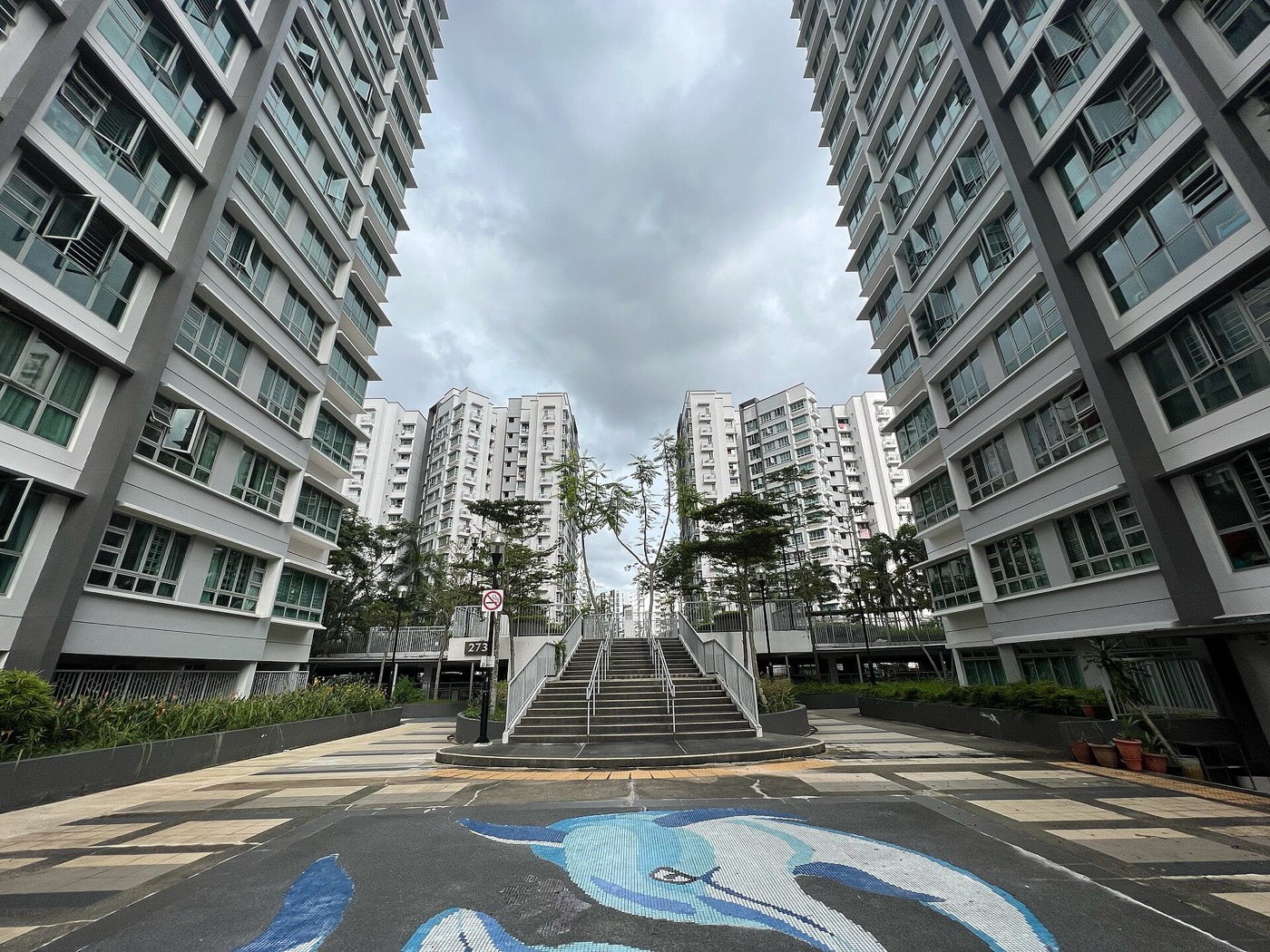
Photo: ZKang123, CC BY-SA 4.0, via Wikimedia Commons.
Room-by-room defects checklist
Bring a roll of blue painter's tape, a coin or the back of a screwdriver for tapping tiles, a torch, a small spirit level, a pail, and a fully charged phone. Mark each defect with tape, then photograph it twice, once close up and once from the doorway so you can tell later which wall it was on.
Walls and ceilings
Shine the torch along the wall at a low angle. It shows patchy paint, bumps and hairline cracks that you will not see head-on. Look for stains, chipped corners at door frames and window reveals, and gaps where the skirting meets the wall. On ceilings, look for water marks, cracks and uneven paint, especially in the toilets and kitchen.
Floors and hollow tiles
Tap every tile with a coin and listen. A dull, hollow sound means the tile is not fully bonded and can crack later. Mark each hollow tile individually rather than writing "hollow tiles in bedroom". Also check for cracked or chipped tiles, uneven grout lines, and tile edges that sit higher than their neighbours.
Doors and windows
Open and close every door and window fully. Doors should swing without scraping the floor and latch without force. Check the main door, the gate, bedroom doors and the household shelter door. On windows, check that each sash slides or swings freely, locks properly, and has no cracked or scratched glass. Look at the rubber seals and the tracks of sliding windows.
Toilets, kitchen and service yard
Pour a pail of water on the toilet floor and watch it. It should run to the floor trap without pooling in a corner. Flush the toilet, run every tap, and look under the basin and the kitchen sink for drips. Check that the floor trap gratings are in place and that the service yard floor drains the same way.
Electrical points (visual check only)
Look, do not open. Check that every switch and socket cover is fitted straight and not cracked, that there are no scorch marks, and that the lights work if the supply is on. Report anything wrong to the BSC. Any wiring work, then or later, needs an EMA licensed electrical worker, not a handyman.
Household shelter
HDB says the shelter's walls, floor, ceiling and door must not be hacked or drilled (HDB, household shelter). Check that the door opens and closes without hitting the skirting tiles, that the handle moves both ways, that the rubber gasket is seated, and that the ventilation sleeve screws are present.
Printable BTO defects checklist
- Photograph every room from the doorway on key collection day
- Walls: cracks, stains, patchy paint, chipped corners
- Ceilings: water marks, cracks, uneven paint
- Floors: tap every tile for hollow sounds, check chips and grout
- Doors: swing, latch, lock, gaps, scratches (main door and gate too)
- Windows: open, close, lock, glass, rubber seals, sliding tracks
- Toilets: water flows to floor trap, flush, taps, no leaks under basin
- Kitchen and service yard: sink drains, no leaks, floor falls to trap
- Electrical: covers straight, no cracks or scorch marks, lights work
- Household shelter: door, handle, gasket, vent screws
- Tape and photograph each defect, close up and wide
- Submit through the Welcome Kit QR code or at the BSC within 1 month
- Attend the joint inspection with your own lock
- Attend the closing inspection and photograph the repaired items
Before renovation starts
Keep your BSC reference and your dated photos in one folder. If a defect is still open when your contractor starts, photograph it again on day one so nobody can argue it was caused by the renovation.
HDB requires you to use a contractor from its Directory of Renovation Contractors (DRC) for all renovations, and works such as hacking need a permit that your contractor applies for electronically on your behalf (HDB, renovation permits). A few rules from HDB's renovation guidelines trip up new owners:
- You must open a utilities account with SP Services before a renovation permit can be granted.
- In newly completed blocks, approved works must be finished within 3 months from the permit date.
- Notify neighbours within 2 units at least 5 days before work begins.
- Toilet floor and wall finishes cannot be replaced for 3 years from the block's completion date, though you can lay new tiles over the existing ones with adhesive.
- Wall fasteners must not exceed 6mm in diameter and 40mm in penetration depth.
- Do not leave appliances in the flat during renovation. Have them delivered after you move in.
If you plan wall hacking, read our HDB wall hacking rules guide first.
The order to do your move-in installs
A common cause of rework is fitting things in the wrong order. A curtain track measured before the false ceiling goes up is the classic example. Use this sequence:
| Step | Install | Why it goes here | Typical Singapore price |
|---|---|---|---|
| 1 | Defect repairs and closing inspection | Rectification has to finish before anything covers it | Free under the DLP |
| 2 | Renovation (carpentry, flooring, false ceiling) | Changes the final window and wall surfaces | Quoted by your DRC contractor |
| 3 | Ceiling lights on existing points | Needs a clear room and ladder access | S$80 to S$120 per fitting plus parts |
| 4 | Curtains and blinds | Measure only after windows, ceilings and carpentry are final | See our curtain price guide |
| 5 | Ceiling drying rack, shelves, mirrors | Fixings must avoid concealed wiring and respect wall limits | Quoted after photos |
| 6 | Furniture assembly | Assemble in the room it will stay in, after floors are protected | S$50 to S$120 per item; wardrobes S$100 to S$250 |
Light fitting and assembly prices are typical Singapore ranges from Helpling, Homejourney, FixMove and Airtasker, not quotes.
Curtain and blind measurements belong after the windows are final because the recess depth, ceiling height and any pelmet decide whether you can use a ceiling track, a wall bracket or an inside-recess blind. Our curtains service measures on site for this reason. If a cat is moving in with you, do the window mesh at the same visit; our cat-proofing guide explains the options.
FAQ
How long is the defects liability period for a new BTO flat? It is 1 year from the date of key collection. HDB follows up on items that need rectification during that year, and after it ends repairs are the owner's responsibility.
When should I report defects after BTO key collection? HDB asks owners to report within 1 month of key collection and before renovation works begin. You can still report later in the year, but it becomes harder to show a defect was not caused by renovation.
How do I report defects to HDB? Scan the QR code in your Welcome Kit or on the notice on your kitchen wall, or go to the temporary Building Service Centre listed in the Welcome Kit. The BSC then arranges a joint inspection.
Can I renovate before HDB fixes the defects? Yes. If your renovation cannot wait, HDB can rectify defects during the renovation (where it does not get in the way) or after it. Report and photograph everything before your contractor starts.
What is covered after the 1-year DLP? HDB lists 5 years of cover for ceiling leakage and external seepage, and 10 years for spalling concrete. The ceiling leakage cover ends if the floor tiles are changed.
Should I give my keys to the rectification contractor? HDB recommends against it. Bring your own lock to secure the flat while the contractor works.
When your defects are closed and you are ready to move in, photograph each window with the frame edges in shot, note the ceiling height, and list the furniture boxes you need assembled. Send that through our move-in and handover packages page and we will quote the installs in the order above.