

An EV charger starts with the board, the by-law, and TR 25
A home EV charger in Singapore is a 7kW single-phase or an 11kW three-phase circuit, not a heavy extension lead. Landed installs are often S$1,800 to S$4,500. Condo installs depend on an MCST resolution and can be S$2,500 to S$8,000 before the building infrastructure. LTA EVCA registration, TR 25:2022 isolation and 6mA DC fault protection, and a load calculation are the parts a socket quote leaves out.



trusted by 500+



Executive summary and why it fails
A home EV charger in Singapore is a 7kW single-phase or an 11kW three-phase circuit, not a heavy extension lead. Landed installs are often S$1,800 to S$4,500. Condo installs depend on an MCST resolution and can be S$2,500 to S$8,000 before the building infrastructure. LTA EVCA registration, TR 25:2022 isolation and 6mA DC fault protection, and a load calculation are the parts a socket quote leaves out.
TR 25:2022 is the Singapore technical reference for electric vehicle charging systems. It expects a dedicated circuit, an emergency isolator that a person can reach, and protection against DC fault current that can blind an ordinary Type AC RCCB. The practical device on many home chargers is 6mA DC residual current detection inside the charger, plus a Type A RCD upstream, or a Type B device where the design says so. A 13A plug-in unit does not meet that bar for a permanent bay, and it is how a household RCCB is held closed by DC leakage it cannot see. The electrical trip guide explains that failure mode.
Single-phase landed boards are commonly 40A or 63A. A 7kW charger is about 32A on its own. Diversity is not hope. The electrician adds the charger to the after-diversity load of the aircons, the cooker and the water heater. If the total does not fit, the choices are a smaller charger, load management that sheds the charger, or a board and incoming upgrade. Three-phase landed supplies can carry an 11kW charger at about 16A per phase, which is often kinder to the board than a 32A single-phase load, but only if the incoming supply is actually three-phase. Many semi-detached houses are still single-phase. Photograph the main switch. Do not guess from the gate.
A condominium carpark lot is common property. The Building Maintenance and Strata Management Act means a subsidiary proprietor cannot run a private cable across the ceiling because the lot was expensive. The MCST application asks for the lot number, the charger model, the fire-stop and cable route, the licensed electrician, and insurance. A refundable deposit is normal. Some buildings already have a shared riser and a by-law. Some require a general meeting before the first charger. LTA EVCA registration is the national record of the charger. It is not a substitute for the MCST stamp. HDB multi-storey carparks are a different public programme and are outside this house-and-condo scope.
Homey Furnishing Pte. Ltd. (ACRA UEN 202018148K), 27 Mandai Estate, #06-10 Innovation Place, Singapore 729931, carries the permit-exempt portion of this work. V On Construction Pte. Ltd. (ACRA UEN 201611708H), listed on the HDB Directory of Renovation Contractors, carries any scope that needs an HDB renovation permit. Those two invoices are not interchangeable. Permanent home chargers follow TR 25:2022, EMA licensing, and LTA EVCA registration. DC fault protection at the 6mA level, or a Type B device, protects the upstream RCCB. Condo cabling on common property needs the MCST under the BMSMA.
Ten-minute diagnostic: safe check versus stop
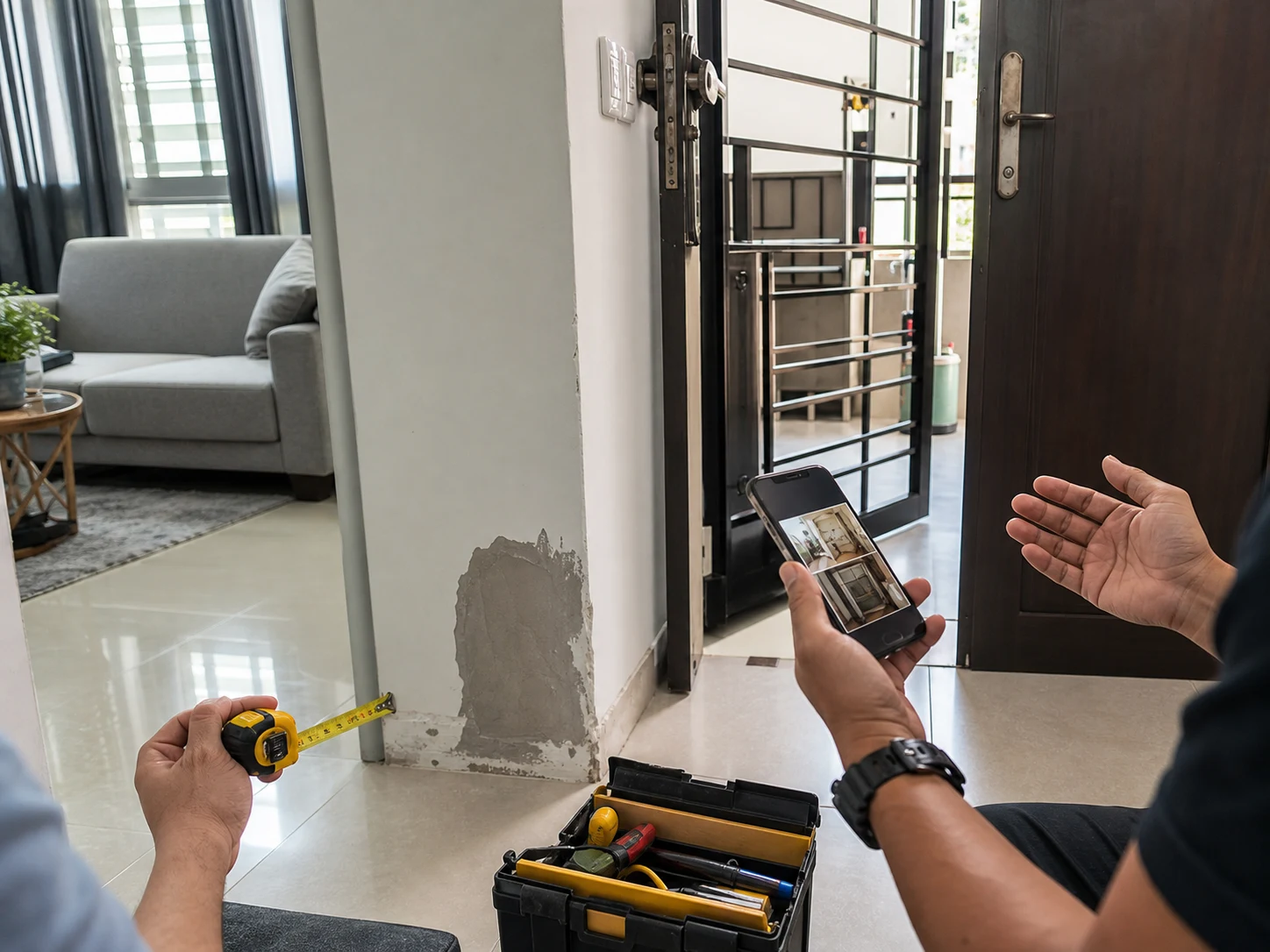
Spend ten minutes with a torch, your phone camera, and a tape before you buy a product or book a hack. Write down what you see. The safe checks below do not ask you to open a live wire, cut a pressurised pipe, or lean out of a window. Read the main switch amps and the number of phases. Measure the cable run from the DB to the bay, including vertical risers. Note whether an isolator can sit within sight of the vehicle.
Stop at the red-flag column. Stop if the quote has no load calculation, no isolator, no 6mA DC protection, or no MCST form for a condo lot. The reason DIY fails is almost never a lack of effort. It is that the tool or chemical makes the next professional repair harder, or it hides a leak, a live conductor, or a deposit line until the damage is larger than S$1,800 to S$4,500 landed. Condo figures depend on the MCST infrastructure..
| Symptom or measurement | Safe DIY check | Red flag: stop | Why DIY fails |
|---|---|---|---|
| Want a charger before the car arrives | Photograph the DB main switch and the carpark lot | You have already bought a charger the building has banned | The model has to match the by-law and the amps |
| Board is 40A single-phase | Do not add 32A on paper without diversity | A quote ignores the oven and the heater | The main fuse then becomes the trip every evening |
| Condo lot, no by-law on file | Ask the management office for the form before any site visit | A contractor offers to core the slab quietly | Common property work without approval is a by-law breach |
| Existing 13A trickle cable | Stop using it as the permanent plan | The cable is warm | A warm 13A lead is the fire TR 25 is written to avoid |
Professional on-site sequence
This is the sequence a careful technician uses so you can tell a shortcut from a finished job. Tools stay in the van. Readings and photos go on the same worksheet as the price. The visit carries a clamp meter, the DB schedule, a cable route drawing, the TR 25 checklist, and the charger datasheet showing 6mA DC detection or the Type B device. Chasing starts after the approvals, not before.
- Step 1. Make the area safe and confirm the symptom still matches the photos. For An EV charger starts with the board, the by-law, and TR 25, that means Stop if the quote has no load calculation, no isolator, no 6mA DC protection, or no MCST form for a condo lot.
- Step 2. Measure before touching the finished surface. Read the main switch amps and the number of phases. Measure the cable run from the DB to the bay, including vertical risers. Note whether an isolator can sit within sight of the vehicle.
- Step 3. Set protection and lay out the tools that belong to this material. The visit carries a clamp meter, the DB schedule, a cable route drawing, the TR 25 checklist, and the charger datasheet showing 6mA DC detection or the Type B device. Chasing starts after the approvals, not before.
- Step 4. Carry out the repair in the order the material allows. a charger is landed on a shared circuit, DC leakage blinds the house RCCB, or common property is cored without approval is the failure this order is written to avoid.
- Step 5. Test in place. The isolator kills the charger. The RCD test is recorded. EVCA registration details are in the pack. The DB schedule names the circuit. The MCST permit is closed if there was one.
- Step 6. Clean, label the photographs against the invoice lines, and leave the statutory openings, weep holes, access panels and labels visible.
The order matters because a charger is landed on a shared circuit, DC leakage blinds the house RCCB, or common property is cored without approval is what happens when a step is rushed. Handover is a measurement, not a handshake. The isolator kills the charger. The RCD test is recorded. EVCA registration details are in the pack. The DB schedule names the circuit. The MCST permit is closed if there was one. If the reading or the water test fails, the visit is not closed and a second line is priced before anyone leaves. Permit work, if the diagnosis has moved into hacking, waterproofing, or a new layout, stops here and is repriced through V On Construction Pte. Ltd. UEN 201611708H.
2026 price, brand and lifespan
The charger hardware is only one line. The cable run, the board work and the building process move the total more than the brand of the wall box. Prices below are 2026 Singapore bands for the described scope. They are not a coupon and they are not a guess after an unopened door. A second trade, such as a PUB licensed plumber or an EMA licensed electrician, is named when the law requires it rather than buried inside the labour line. Compare rows by what they include. The planning-life column belongs to that row only.
2026 SGD scope bands
| Scope | What you are paying for | 2026 SGD band | Planning life |
|---|---|---|---|
| Load study and application pack | DB photos, diversity, MCST or landed paperwork | S$180 to S$450 | The pack, before hardware |
| Landed 7kW single-phase | Dedicated circuit, isolator, 6mA DC protection, commissioning | S$1,800 to S$3,200 | The life of the charger, typically 8 to 12 years |
| Landed 11kW three-phase | Only where the incoming supply is three-phase | S$2,800 to S$4,500 | Same hardware life, kinder load per phase |
| Condo lot on an approved riser | Electrician, cable, charger, deposit excluded | S$2,500 to S$8,000 | Building infrastructure can exceed the charger |
Brand, material and lifespan
| Option | Where it is used in Singapore | Failure mode in humidity | Planning life |
|---|---|---|---|
| Wallbox with 6mA DC detection | Landed wall beside the bay | Useless if the board cannot spare 32A | Match the detection to TR 25 |
| Type B upstream device | Where the charger does not contain 6mA detection | Cost and board space | Required when the datasheet says so |
| Load-management charger | 40A boards that cannot take 32A continuous | Needs a meter the electrician trusts | Cheaper than an incoming upgrade |
| 13A portable | Overnight top-up only, not a designed bay | Heat, and DC leakage into a Type AC RCCB | Not the permanent install |
Price the real install on the EV charger page and in the cost calculator. A condo deposit is the MCST line, not the electrician line.
Three Singapore property case studies
Three worked jobs show how the same symptom is priced differently in a new BTO, an older resale flat, and a private condo or landed house. The totals are the lines a household actually paid, not a national average. Permit-exempt invoices are issued by Homey Furnishing Pte. Ltd. UEN 202018148K.
Case 1: landed terrace in Seletar
A 63A single-phase board had room for 32A after diversity. A 7kW charger, isolator and Type A protection with 6mA detection in the unit was S$2,650. One day on site after EVCA paperwork. The oven circuit was left alone.
Case 2: semi-detached in Bukit Timah
The owner had assumed three-phase. The main switch was 40A single-phase. Load management and a 7kW charger limited to the spare amps was S$3,150. An incoming upgrade was quoted separately and not taken.
Case 3: condo lot in Marine Parade
The MCST already had a riser by-law and a S$1,000 deposit. The subsidiary proprietor pack, the licensed install and a 7kW charger came to S$4,200 plus the deposit, which was returned after inspection. No slab was cored on the day the quote was signed.
The driveway, the board, and the approval that has to come first
Frequently Asked Questions
What is LTA EVCA registration?
It is the national registration of the charger. The electrician or the owner completes it as part of commissioning. It does not replace an MCST approval, and it does not create spare amps in the board.
What does TR 25:2022 ask for at a home bay?
A dedicated circuit, an emergency isolator, and protection against DC fault current so the upstream RCCB is not blinded. Many chargers include 6mA DC detection. Where they do not, the design uses a Type B device. A 13A socket is not that design.
Will a 40A single-phase board take a 7kW charger?
Sometimes, after diversity. A 7kW charger is about 32A. If the evening load of aircon, cooking and water heating already uses the board, you need load management or an upgrade. Three-phase 11kW is about 16A per phase and only exists if the incoming supply is three-phase.
Can a condo owner install a charger alone?
No. The lot ceiling and risers are common property under the BMSMA. You need the subsidiary proprietor application, the building by-law, and usually a refundable deposit. A quiet core drill is a breach, not a shortcut.
Who signs the electrical work?
An EMA licensed electrician. Homey Furnishing Pte. Ltd. UEN 202018148K coordinates the survey. The test record and the isolator demonstration are the handover.
Does this apply to an HDB carpark?
No. HDB public carparks follow a different programme. This guide is landed property and private condominiums. Do not plan a private cable in an HDB deck from this page.