

Shop window decals and vinyl
Shop window vinyl is quote on inspection to apply and to strip. It is not a car decal and it is not the home window-film page. We do not print the vinyl in this catalogue.


trusted by 500+
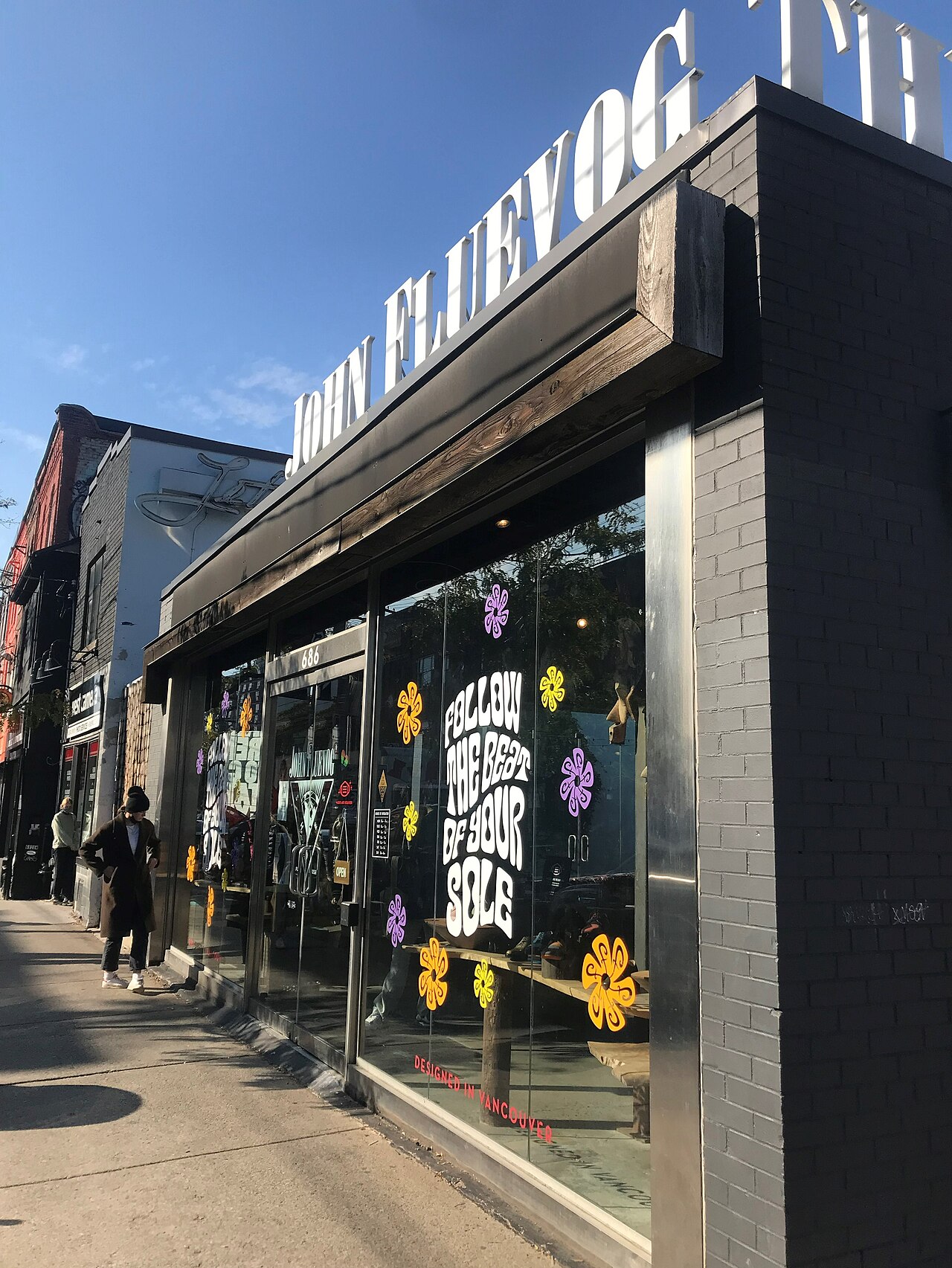
Photo: DocumentationAdjacent, CC BY-SA 4.0, via Wikimedia Commons. Promotional vinyl on a Toronto shop window. It is not a Singapore decal and not a home window film.


How it works
- 1
Send the glass size, whether the film is inside or outside, and a photo of any vinyl already on the pane.
- 2
We say quote on inspection. There is no per-square-foot vinyl band.
- 3
If the glass is a landlord’s shopfront and the lease forbids applied film, the visit does not start.
- 4
You confirm the quote. Printing stays with the maker. Home frosting and car graphics are different pages or different trades.
What this job is
Autocomplete for “window decal shop Singapore” drifts to car decals, and “how much do window decals cost” has no local band on this site. A shop window graphic is quote on inspection. The printer’s price for the roll is the printer’s price. Application and, more often than people expect, removal of the last tenant’s film are the visit. If your photo is a car door, this is the wrong page. If your photo is an HDB bedroom needing frost, use the window film pages. Those films are a residential product with their own sentences. They are not a shop hours panel.
Glass in a shopfront is usually tempered or laminated in the door and annealed or laminated in the fixed pane. The film does not care about the temper. The edges do. A blade that cuts the old vinyl must not score the glass. A score on tempered glass is how a door explodes later, not during the cut. Good removal uses plastic blades and adhesive remover suited to the film, then a wash. Sloppy removal uses a steel scraper, leaves a haze, and scratches the low-iron glass the landlord just paid for. That scratch is not “part of vinyl removal”. It is damage.
Inside versus outside is a durability choice and sometimes a permission choice. Film on the inside of an air-conditioned line is out of the rain and the sun’s worst. Film on the outside fades, the edges lift, and it is clearly a mark on the public face. BCA defines outdoor as a roofed space not fully enclosed on all sides that pedestrians use or that is open to the public. A decal inside a sealed mall shop, on the tenant’s own glass, may not be that outdoor sign. A decal on the street pane, readable as the shop’s advertisement, should be treated as outdoor until ALS says licence not required. The film area still counts if a licence is required. BCA’s fee examples include stickers as a way of measuring area. We do not promise a 5 square metre exemption. Signboards have the exemption BCA describes. An advertisement sticker may not.
Curtains, blinds and roller shades are not part of this booking.
How the work is done
Application starts with glass that is chemically clean, not just wiped. Silicone residue, the previous adhesive, and glass cleaner with additives all reject acrylic adhesive. The shop should be at a temperature where the film can be squeegeed. In a hot five-foot way the adhesive grabs before the graphic is positioned. That is when fitters stretch the film to force a bubble out, and the logo distorts. Wet application, with the slip solution the film maker specifies, is the usual method for a large print. Dry application suits small cut letters. Mixing them because the bottle was empty is how lettering clouds.
Cut vinyl letters are weeded, taped, and transferred. The transfer tape comes off at a shallow angle. If it lifts the letter, the glass was not clean or the tape was wrong for the film. Printed wraps on a window are hinged at the top and squeegeed down. A window with muntins is several panels, not one sheet forced over the bars. Forcing the sheet over a bar leaves a bridge that fails in a month. Perforated one-way film needs the holes clear. A laminate put on the wrong face, or a squeegee that fills the holes with adhesive, kills the one-way effect and the outward view from the shop.
Safety and landlord lines matter as much as bubbles. Many mall manuals ban full-height film that makes the shop look closed, or they set a maximum coverage so the mall’s own directory can still be read through the line. A food shop may also have NEA or SFA expectations about what the front shows. We do not interpret those licences. We do refuse film that covers an SCDF exit sign or that sits in the line of sight the Fire Code tells you to keep clear. Clause 8.1 says a brightly illuminated sign or a display must not impair the exit sign. An opaque hours panel stuck across the exit sign is the obvious version of that mistake.
Removal of failed vinyl is heat or a solvent the film maker names, a plastic blade, and time. Purple adhesive left from a cheap calendar vinyl does not “wipe off”. Budget the strip as its own line, quote on inspection, before you promise the landlord a clear pane by noon. A small patch of adhesive that has etched the glass may not come clear. We will say so rather than polish a hole in the coating. After a clean removal, new film can go on. Putting new film over old film is the sloppy job. It looks thick at the edges and the old colour shows through when the sun is behind it.
| What you should see at the end | What a sloppy visit leaves | Why it matters |
|---|---|---|
| Glass clean, film not stretched, transfer tape off cleanly | Bubbles, a stretched logo, tape left in the serifs | The hours are unreadable |
| Old adhesive removed first | New film over old film | The ghost of the last tenant remains |
| Plastic blade on the glass | A steel scraper on tempered glass | A scratched or shocked pane |
| Exit sign left visible | Opaque vinyl across the exit sign | The Fire Code problem is now a graphic |
How to scope it
Measure each pane, not the whole shopfront as one rectangle. A door leaf, a sidelight and a transom are three applications. Say which are tempered if you know. Send the artwork with a scale, or the printer’s file name, and say inside or outside. If the mall has a coverage limit, send the clause. We will not guess “about half”.
Car graphics, vehicle wraps and number-plate surrounds are not this visit. Residential heat-rejection film and decorative frost are the window-film pages. A shop that wants both a street vinyl and a frost on an internal office is two lines. Curtains, blinds and roller shades are not a substitute for the vinyl and are not part of the booking.
| What you see | What to photograph | Stop |
|---|---|---|
| Clean glass, new cut letters, landlord allows film | Pane sizes | Quote on inspection |
| Purple adhesive from old vinyl | How long it has been baked on | Strip first. Quote the strip separately from the new film |
| Film requested over the exit sign | The sight line | Refuse that position |
| Full-height opaque film in a mall | The mall manual | Stop if the manual forbids it |
| The photo is a car window | Wrong trade | Do not price it as a shop |
Which job you actually have
Name the film. The price stays quote on inspection either way.
| Situation | Use this | Leave this alone |
|---|---|---|
| Cut letters or a printed hours panel | quote on inspection | A car-decal package |
| Perforated one-way graphic | quote on inspection | Ordinary frost from the home film page |
| Old vinyl to strip | quote on inspection | New film laid on top |
| Home bedroom frost | Window-film pages | This shop page |
| Vinyl on a fascia panel, not on glass | Fascia or repair page | A glass method on a composite panel |
Questions a business should ask
Questions a business should ask
Ask the printer and the fitter.
- Is the film inside or outside, and who prints it?
- What is on the glass now, and does it have to come off first?
- Which panes are in scope, and are any of them doors that must still close?
- Does the lease or the mall limit coverage?
- Will any part cover an exit sign or a fire notice?
- Is this a shop pane or a car, and is it glass or a fascia panel?
- If the street face is an advertisement, has anyone checked ALS?
Glass that is not yours to film
Tenant glass, landlord glass and a conserved shopfront are three permissions.
| Glass | Ask | Film | We will not |
|---|---|---|---|
| Your own shop pane, lease allows it | Inside or outside | Quote | Cover the exit sign |
| Mall shopfront | The manual’s coverage rule | Quote if allowed | A full blackout because the print was easier |
| Conserved shopfront | URA’s rule against covering architectural features | A graphic that respects the pane | A wrap over muntins and ornament |
| HDB shop | HDB positions if it reads as the signboard | Quote | Treat a full-height ad as automatically exempt |
Rules that apply
BCA’s outdoor definition and the signboard-versus-advertisement split decide whether a street-facing graphic needs a licence. Stickers are one of the area examples in BCA’s fee computation note. A 5 square metre exemption is described for signboards, not as a general permission for advertisements. Submit rather than assume. URA’s conservation page says signs must not cover key architectural features. A window graphic that paints out a conserved transom is a sign, not a decoration.
SCDF’s exit-sign sight line is not optional. NEA and SFA may care what a food shop shows on the front. We do not certify those. We also do not apply residential window film under a shop price. Electrical signs in the same window, if you add neon behind the vinyl, follow the neon page and need an electrician when the cable is new.
Official pages
- BCA: outdoor advertising sign and signboard licence
- URA: signs in conservation areas
- BCA Advertisement Licensing System: frequently asked questions
Homey Furnishing Pte. Ltd. (ACRA UEN 202018148K), 27 Mandai Estate, #06-10 Innovation Place, Singapore 729931, invoices the permit-exempt visit. V On Construction Pte. Ltd. (ACRA UEN 201611708H), on the HDB Directory of Renovation Contractors, invoices hacking, a new layout, and an HDB renovation permit. Homey Furnishing is not a property agency, not a CEA practice, and not a MOM-licensed employment agency.
How you're charged
How you're charged
A job that already has a sentence on HomeySG uses that sentence. The hour is not added on top of a band unless the written scope says so. There is no fuel surcharge and no published night premium except the mall overnight row.
| Charge | What it covers | 2026 |
|---|---|---|
| Per hour | Permit-exempt handyman time after a priced task, if the scope says so | S$45/hr |
| Minimum, one task | One permit-exempt task on one visit | S$55 |
| Mall overnight | Permit-to-work admin and one hardware fix when the mall requires the night slot | S$380 to S$650 |
| A matching catalogue row | The photo matches a row already printed | That row |
| A term contract, a sign, a plain office closer, a mineral ceiling tile | No catalogue row for that product | quote on inspection |
Application and removal are quote on inspection. No vinyl rate is printed. A hole in the wall from a previous illuminated sign is the patch sentence only when it matches, S$150 to S$280.
Ways to keep the bill smaller
Ways to keep the bill smaller
- Strip the old film in the same visit as the new one. A second call-out to remove ghosts costs more than an hour of solvent now.
- Apply inside if the lease allows it and the graphic still reads. Outside film is the one that lifts.
- Weed and proof the spelling before the transfer tape is on the glass. Site corrections are a new piece of vinyl.
- Do not order perforated film for a pane that must stay clear for an exit sign.
WhatsApp the photos to +65 8561 0630.
Price, or quote on inspection
Vinyl has no catalogue row. A neighbouring patch row exists for holes, not for adhesive.
Anything not in that table is quote on inspection.
| Scope already published | 2026 band in the repo | Where it lives |
|---|---|---|
| The sign, letters, face, vinyl or neon | quote on inspection | No fabrication band and no mounting band |
| Small hole patch after a fixing comes out | S$150 to S$280 | Only when the photo matches that patch sentence |
| Micro-reinstatement at lease end | S$1,800 to S$4,500 | Reinstatement page, when the lease asks for that scope |
| Mall overnight, permit-to-work admin and one hardware fix | S$380 to S$650 | Only when the mall’s ask matches that row |
WhatsApp the photos to +65 8561 0630. The reply uses a band already printed on HomeySG, or it says quote on inspection.
Related pages
Frequently Asked Questions
How much do shop window decals cost in Singapore?
Quote on inspection. Printing is the maker’s line. Applying and stripping are quoted from the panes and the condition of the glass. No per-square-foot band is published.
Can you remove old shop window stickers?
Yes. Adhesive that has baked on is part of the quote, not a free extra. New film is not laid over old film. A steel scraper on the glass is refused.
Is this the same as car window decals?
No. Car graphics are a different trade. This page is shop glass.
Is this the same as HDB window film?
No. Heat-rejection and decorative films for homes are the window-film pages. A shop hours panel is this page.
Do window stickers need a BCA licence?
If they are an outdoor advertisement or signboard under BCA’s definition, and no exemption applies, yes. A sticker’s area is one of the measurements BCA illustrates. ALS confirms the category. A landlord can forbid film even when a licence is not required.
Can the decal cover the exit sign?
No. SCDF’s clause 8.1 keeps the exit sign visible. A graphic that impairs it is refused.