

A new smell is a resin problem, and SS 554 has a number for it
Formaldehyde after a Singapore renovation comes from urea-formaldehyde resin in carpentry, not from the paint smell you notice first. SS 554:2016+A1:2021 sets an indoor limit of 0.08 ppm, about 0.1 mg/m³. A 4-room HDB photocatalyst treatment is from S$328 to S$900. Baking the flat, a carbon purifier, and a photocatalyst are not the same tool. E0 and ENF boards were the better purchase. E1 and unknown Taobao board are why the meter stays high.


trusted by 500+


Executive summary and why it fails
Formaldehyde after a Singapore renovation comes from urea-formaldehyde resin in carpentry, not from the paint smell you notice first. SS 554:2016+A1:2021 sets an indoor limit of 0.08 ppm, about 0.1 mg/m³. A 4-room HDB photocatalyst treatment is from S$328 to S$900. Baking the flat, a carbon purifier, and a photocatalyst are not the same tool. E0 and ENF boards were the better purchase. E1 and unknown Taobao board are why the meter stays high.
Urea-formaldehyde resin is the glue in a great deal of plywood and particleboard. E1 is a common legal grade and it still emits. E0 emits less. ENF, the extra-low grade used in better recent boards, emits less again. A Taobao or marketplace carcass with no grade mark is a guess, and the guess is often worse than E1. The emission rises with heat and humidity, which is the Singapore bedroom with the door closed and the wardrobe backed onto an unsealed MDF sheet. Paint odour is mostly solvent and it fades in days. Formaldehyde from resin fades in weeks or months, and a closed flat holds it.
SS 554:2016 with amendment A1:2021 is the Singapore standard people mean when they ask whether the air is acceptable. The formaldehyde reference used in practice for indoor air is 0.08 ppm, in the order of 0.1 mg/m³. A single sniff is not that measurement. A photoionisation detector or a formaldehyde meter, used after the flat has been closed up long enough to mean something, is the number. Treating a flat that already reads under the limit is a comfort spend. Treating a nursery that reads well over it is the point of the service. The estimator asks for rooms and carpentry load because the number scales with the boards, not with the floor area alone.
Three tools get sold as if they were one. Bake-out heats and ventilates so the resin gives up vapour while you are not living there, then you air the flat. It is slow and it is real. An activated-carbon purifier adsorbs vapour while it runs and while the carbon is fresh. It does not change the board. A dark-active amino-polymer plus titanium dioxide photocatalyst is applied to surfaces so the chemistry keeps working after the crew leaves, including with less light than a simple TiO2 paint needs. None of them un-glues a cheap wardrobe. If the reading is extreme, the honest option is to replace the ungraded backing boards and then treat. Homey Furnishing does not promise a zero reading from a spray.
Homey Furnishing Pte. Ltd. (ACRA UEN 202018148K), 27 Mandai Estate, #06-10 Innovation Place, Singapore 729931, carries the permit-exempt portion of this work. V On Construction Pte. Ltd. (ACRA UEN 201611708H), listed on the HDB Directory of Renovation Contractors, carries any scope that needs an HDB renovation permit. Those two invoices are not interchangeable. SS 554:2016+A1:2021 is the indoor air reference, with formaldehyde discussed at 0.08 ppm, about 0.1 mg/m³. Treatment products are used as labelled. This is not a renovation permit item.
Ten-minute diagnostic: safe check versus stop
Spend ten minutes with a torch, your phone camera, and a tape before you buy a product or book a hack. Write down what you see. The safe checks below do not ask you to open a live wire, cut a pressurised pipe, or lean out of a window. Close the flat for the period the meter protocol uses, then read formaldehyde in the worst room, usually the new wardrobe bedroom. Note board grades if they are stamped. Write the number down before you buy a machine.
Stop at the red-flag column. Stop if a seller promises zero formaldehyde without a measurement, if you are about to heat a flat you are still sleeping in, or if the carpentry is ungraded and nobody has talked about replacing the worst boards. The reason DIY fails is almost never a lack of effort. It is that the tool or chemical makes the next professional repair harder, or it hides a leak, a live conductor, or a deposit line until the damage is larger than A 4-room HDB photocatalyst treatment is from S$328 to S$900. New carpentry is a different budget..
| Symptom or measurement | Safe DIY check | Red flag: stop | Why DIY fails |
|---|---|---|---|
| New wardrobe, sore eyes | Air the room and book a meter, not a scented candle | You sleep there with the doors shut because the purifier light is on | A purifier is not a licence to close the room up |
| Boards have no E0 or ENF mark | Photograph the packing or the edge stamp | You assume E1 because the carpenter said so | Ungraded board is not E1. The reading will say |
| Only the paint smells | Wait a few days of ventilation and reassess | You book a full photocatalyst for a solvent smell | Solvent odour is not the resin problem |
| A baby arrives this week | Measure before the cot is used | You rely on a plant | A plant is not an SS 554 control |
Professional on-site sequence
This is the sequence a careful technician uses so you can tell a shortcut from a finished job. Tools stay in the van. Readings and photos go on the same worksheet as the price. A formaldehyde meter, ventilation plan, and either a surface photocatalyst system or a carbon plan sized to the reading. Bake-out uses heat and planned airing, not a closed hot room with people in it.
- Step 1. Make the area safe and confirm the symptom still matches the photos. For A new smell is a resin problem, and SS 554 has a number for it, that means Stop if a seller promises zero formaldehyde without a measurement, if you are about to heat a flat you are still sleeping in, or if the carpentry is ungraded and nobody has talked about replacing the worst boards.
- Step 2. Measure before touching the finished surface. Close the flat for the period the meter protocol uses, then read formaldehyde in the worst room, usually the new wardrobe bedroom. Note board grades if they are stamped. Write the number down before you buy a machine.
- Step 3. Set protection and lay out the tools that belong to this material. A formaldehyde meter, ventilation plan, and either a surface photocatalyst system or a carbon plan sized to the reading. Bake-out uses heat and planned airing, not a closed hot room with people in it.
- Step 4. Carry out the repair in the order the material allows. a carbon box is left to stand in for a measurement, or a bake-out is run while the household sleeps there is the failure this order is written to avoid.
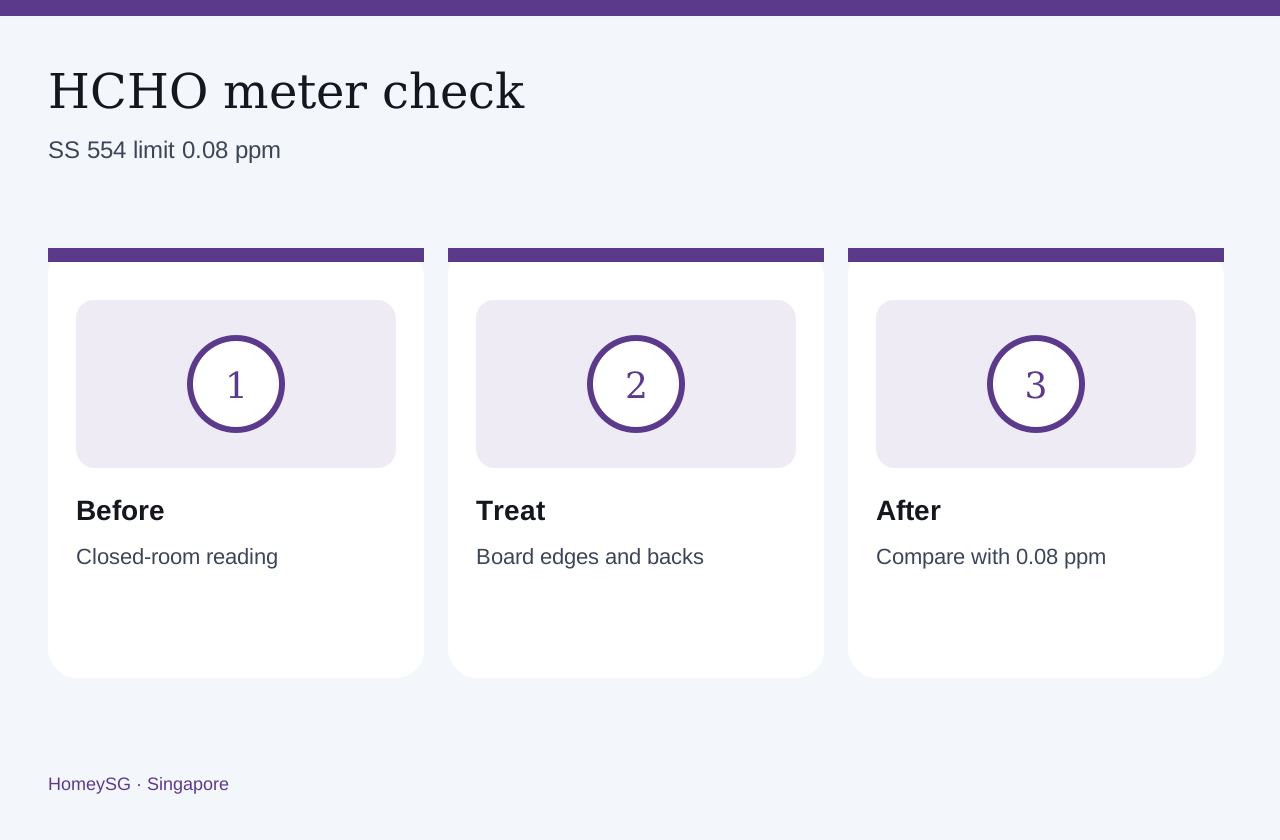
- Step 5. Test in place. You get the before reading, the method, and an after reading taken under the same closed-up rule. If the after reading is still over 0.08 ppm, the next step is more airing or replacing boards, not a stronger candle.
- Step 6. Clean, label the photographs against the invoice lines, and leave the statutory openings, weep holes, access panels and labels visible.
The order matters because a carbon box is left to stand in for a measurement, or a bake-out is run while the household sleeps there is what happens when a step is rushed. Handover is a measurement, not a handshake. You get the before reading, the method, and an after reading taken under the same closed-up rule. If the after reading is still over 0.08 ppm, the next step is more airing or replacing boards, not a stronger candle. If the reading or the water test fails, the visit is not closed and a second line is priced before anyone leaves. Permit work, if the diagnosis has moved into hacking, waterproofing, or a new layout, stops here and is repriced through V On Construction Pte. Ltd. UEN 201611708H.
2026 price, brand and lifespan
Measurement is the first line. Treatment is the second. Replacing boards is the third and is not hidden inside a spray price. Prices below are 2026 Singapore bands for the described scope. They are not a coupon and they are not a guess after an unopened door. A second trade, such as a PUB licensed plumber or an EMA licensed electrician, is named when the law requires it rather than buried inside the labour line. Compare rows by what they include. The planning-life column belongs to that row only.
2026 SGD scope bands
| Scope | What you are paying for | 2026 SGD band | Planning life |
|---|---|---|---|
| Meter survey | Closed-up reading, worst rooms | S$120 to S$220 | The number you decide on |
| Carbon and ventilation plan | Machines and a week of airing | S$280 to S$500 | While the carbon is fresh |
| Photocatalyst treatment, 4-room HDB | Amino-polymer and TiO2 on carpentry surfaces | S$328 to S$900 | Keeps working after the visit |
| Replace ungraded backing | Carpentry, then retest | S$300 to S$800 | When the board is the source |
Brand, material and lifespan
| Option | Where it is used in Singapore | Failure mode in humidity | Planning life |
|---|---|---|---|
| E1 board | Common legal carpentry | Still emits, more in heat and humidity | Acceptable is not zero |
| E0 and ENF | Better new kitchens and wardrobes | Lower emission, not a sealed room | The purchase that avoids the meter |
| Ungraded particleboard | Some imported flat-pack | The high readings | Replace the worst panels |
| Carbon versus photocatalyst | Different physics | Carbon saturates. Catalyst needs the right chemistry | Match the reading |
Book the formaldehyde service and use the estimator. Bring any board stamps you have.
Three Singapore property case studies
Three worked jobs show how the same symptom is priced differently in a new BTO, an older resale flat, and a private condo or landed house. The totals are the lines a household actually paid, not a national average. Permit-exempt invoices are issued by Homey Furnishing Pte. Ltd. UEN 202018148K.
Case 1: 4-room BTO in Tampines
E1 wardrobes, reading 0.11 ppm in the bedroom after a closed-up test. Ventilation plus a photocatalyst treatment at S$680. After reading 0.06 ppm. They moved the cot in after the second reading, not before.
Case 2: resale flat in Clementi with new Taobao wardrobes
No grade mark. Reading 0.18 ppm. Backing boards replaced for S$540 and a treatment at S$500. The second reading was 0.07 ppm. A purifier-only quote was declined because the source was still in the room.
Case 3: condo in Novena
The smell was paint. Reading 0.04 ppm. No treatment sold. Two days of airing and the solvent odour dropped. The meter saved a S$900 visit they did not need.
The boards, the meter, and the treatment that matches the number

Frequently Asked Questions
What is the SS 554 formaldehyde figure?
The indoor reference used from SS 554:2016+A1:2021 is 0.08 ppm, about 0.1 mg/m³. A smell is not that figure. Take a closed-up meter reading and write it down before you buy a treatment.
E1, E0 or ENF?
All three are grades of resin emission. E1 is common and still emits. E0 is lower. ENF is lower again. A board with no stamp is not any of those grades. Ungraded particleboard is the usual reason a bedroom stays high.
Does a carbon purifier fix the wardrobe?
No. It adsorbs vapour while the carbon is fresh and the machine runs. The resin is still in the board. It is a bridge while you air the flat, not a rebuild.
What is the photocatalyst option?
A dark-active amino-polymer with titanium dioxide, applied to the carpentry so the reaction continues after the crew leaves. It is not a perfume. If the reading is still high afterwards, the boards themselves are the next conversation.
Is bake-out safe to sleep through?
No. Bake-out heats the resins so they emit, and you ventilate while the flat is empty. Sleeping in a closed hot room is the opposite of the method. Air the flat before anyone moves back.
Is treatment worth it?
When the reading is over 0.08 ppm in a room you will sleep in, yes. When the reading is already under the limit, airing is the spend. Surveys start at S$120. A 4-room HDB photocatalyst treatment is from S$328 to S$900. Homey Furnishing Pte. Ltd. UEN 202018148K does not sell a spray without the number.