

Solid wood, plywood, MDF and the humidity that actually fails the piece
Singapore rooms cycle between air-conditioning and a shut, wet evening. Solid wood moves. Particle board under a leak swells and stays swollen. Plywood and MDF are not the same board. This guide says which failure you are looking at. It does not add a teak rate, a veneer rate, or a foot-run.


trusted by 500+
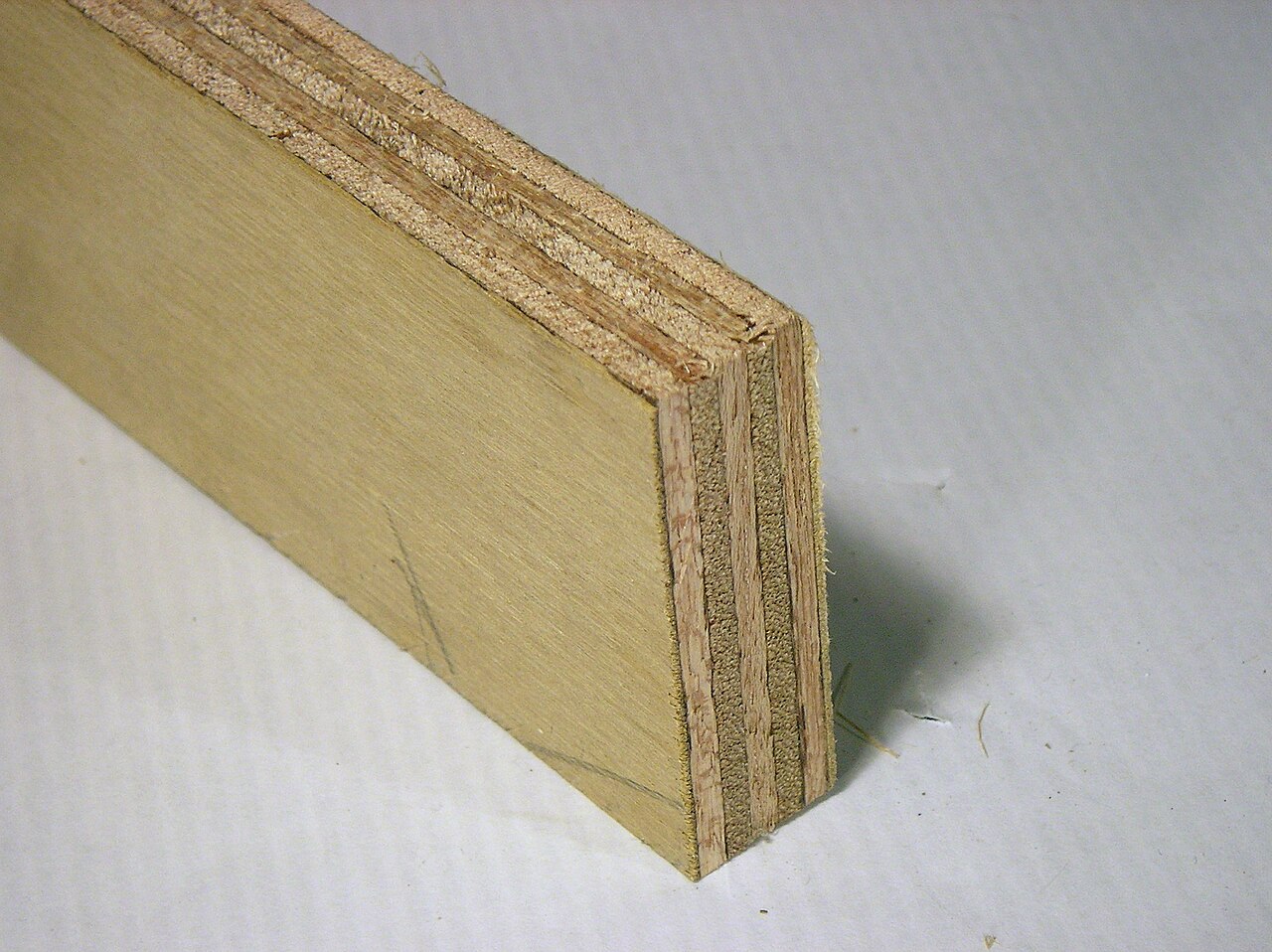
Photo: Rotor DB, CC BY-SA 3.0, via Wikimedia Commons. Plywood sheets. They are not a HomeySG material grade and not a price list.


How it works
- 1
Send one photo of each piece, the block, and whether the home is HDB, condo or landed.
- 2
We match a band already printed on HomeySG, or we say quote on inspection.
- 3
A layout change, hacking, or a built-in strip-out is named as V On Construction. A truck is not included.
- 4
You confirm the scope before anyone comes. Curtains, blinds and roller shades stay off the booking.
What this job actually is
Last updated 31 October 2026.
Searches for solid wood furniture, veneer versus laminate, and plywood versus MDF want a winner and a price. Shop pages award both. HomeySG will not. The finish comparison between laminate and veneer is already at laminate versus veneer. Read that note for the surface. This guide is the core under the surface, and what Singapore humidity and a real leak do to it. If you only needed the finish page, stop there. Staying here will not produce a surcharge to add to a quote.
Solid wood is a plank or a set of planks, not a printed picture of grain. It takes and gives up moisture. A dining top glued so it cannot move can split or cup when the room is shut and wet at night and cold in the afternoon under the air-conditioner. That is a reason to design for movement. It is not a reason to publish a teak, suar, oak or walnut price. Those rates on shop sites are theirs. A solid lip on a table is also not proof that the centre is solid. Look at the edge and, if there is a cut, at the core. We will not certify a species from a photograph of the grain.
Veneer is a thin face on a core. Laminate is a harder printed or solid-colour skin. Both can look like timber. Both can peel when the core has swollen or when water sat in a joint. A peeled face on a room door, when the core is sound, can be the door page’s veneer or pet-scratch patch at S$160 to S$350. That sentence is a door. It is not a dining table and not a wardrobe door full of particle board that has already blown. A cabinet door whose laminate has lifted because the board is soft is quote on inspection, unless the photo is the under-sink repair. The kitchen numbers are specific: a base board is S$280 to S$450, base plus gable plus plinth is S$450 to S$700, and a PVC-foam or aluminium conversion after a repeat failure is S$550 to S$900. Those rows exist because particle board under a sink drinks the leak. They are not a general “MDF price”.
Plywood is veneers crossed so the sheet is more stable than a plank in one direction. It still delaminates if it is soaked, and a long shelf still sags if the span and the load are wrong. MDF is a fibre board. It machines cleanly and it swells at a raw edge if water reaches it. Particle board is the chip core inside a great deal of flat-pack and a great deal of failed sink cabinets. People say “plywood” when they mean any of the three. Send a photo of a raw edge. We will not guess the board from the brand of the wardrobe. A span table for “how far MDF can span” is the same kind of guess. Tell us the span and whether the load is paperbacks or files. The bookshelf page refuses a made-up maximum.
Repairs that already have a sentence stay on their pages. Soft skirting from S$240 to S$580 for 10m to 30m is the termite and water-damaged skirting page when that length matches, not a furniture-material extra. New boards that smell can take a spot treatment of up to three pieces at S$180 to S$280. That treatment is not included in assembly and it is not a material upgrade. A parquet patch of 1 to 3 square metres at S$250 to S$580 is the floor, which matters under a platform bed and is not part of the bed. None of these rows is a reason to strip a sound carcass because the face is out of fashion.
Permission does not change with the board. A loose plywood bookcase is not an HDB renovation. A particle-board kitchen that is being hacked out is. HDB’s renovation page and the fine of up to $5,000 apply to a renovation that breaches the rules. SCDF clause 7.2 does not become optional because the shelf is “only MDF”. Do not screw any board into a shelter wall. BCA plan approval is about building works, not about whether the top is oak or laminate. Curtains are not a material in this comparison.
Homey Furnishing Pte. Ltd. (ACRA UEN 202018148K), 27 Mandai Estate, #06-10 Innovation Place, Singapore 729931, invoices permit-exempt furniture assembly and repair. V On Construction Pte. Ltd. (ACRA UEN 201611708H), on the HDB Directory of Renovation Contractors, invoices an HDB renovation permit when the work is a new layout, hacking, or a built-in strip-out. Homey Furnishing is not a removal company and does not publish a truck rate.
Curtains, blinds and roller shades are not part of this booking. Fabric window treatments are a different product, and these pages do not quote them.
What to do first
Name the core from an edge, not from the advertisement.
- Photograph a raw edge or a drilled hole, not only the face.
- Say whether the piece got wet or only lives in a humid room.
- Match a sink-base repair before you replace a kitchen for a peeled door.
- Do not ask for a teak price, a plywood price, or a span chart.
- Read the laminate-versus-veneer note if the question is only the face.
| What you see | Safe check | Stop |
|---|---|---|
| Sink base is soft | Particle board drank a leak | S$280 to S$700 on the repair path |
| Door face peeled, core sound | Door patch, if it is that door | S$160 to S$350 |
| Solid top has cupped | Movement, not a polish | quote on inspection |
| Long shelf has sagged | Span and core | quote on inspection |
HDB, condo and landed
The building changes the permission and the disposal path. It does not invent a second price.
| Question | HDB | Condo | Landed |
|---|---|---|---|
| HDB | Closed bedrooms and service-yard kitchens are the wet cycle. The board does not change the permit. | Shelter walls are refused for every material. | A leak is fixed before a new panel. |
| Condo | The same boards. Air-conditioning all day and a shut room at night is still a cycle. | No condo timber rate. | A balcony piece gets rain as well as humidity. |
| Landed | The same boards. Ground-floor timber can also be a termite question. | Skirting has its own bands. | A species name is still not a price. |
What to ask a workshop without adopting their rate
Ask what the core is, whether a solid top can move, and what happens at a raw MDF edge in a kitchen. Ask for the span of any shelf and the thickness of the board. Ask whether the sink base is the same particle board as the tall unit. Those questions sort a quote. They do not require you to accept a per-foot number from the same brochure. If the workshop will not say the core, do not fill the gap with a guess from a blog.
“ENF”, “E0” and “E1” appear on carpenter pages as formaldehyde grades. They are labels on somebody’s board certificate. HomeySG does not reprint a grade as a promise about your panels, and it does not add a price for a grade we have not seen on an invoice for your job. If a smell is the complaint, the spot treatment at S$180 to S$280 for up to three pieces is the sentence that exists. It is not a certificate.
Where each material shows up in a flat
A dining table is where solid wood is asked for, and where a veneered plywood top is often what arrives. The dining-table page is the quote. A platform bed is where a solid plinth traps moisture, which is why the bed page refuses to seal it to a damp floor. A study table is where a long particle top sags between two legs. A TV console is where a printed laminate face meets a hinge that has pulled out of a soft core. A bookshelf is the span problem. A wardrobe from a carton is usually a particle or honeycomb core, and the assembly band does not change because the face is called oak.
Kitchens remain the place the material is not a style choice. Water plus particle board is the swollen base. PVC foam or aluminium is the conversion at S$550 to S$900 when the cabinet has failed twice and the leak is fixed. That is a wet box. It is not a reason to build the bookshelf in aluminium, and it is not a reason to price the dining table as a kitchen.
What this guide will not settle
It will not tell you the best wood. It will not convert a showroom’s solid-wood premium into our quote. It will not rank teak against oak. It will not set a moisture percentage the room must hold, because we have not measured your room. A hygrometer reading you took is useful in the WhatsApp message. A number copied from another city is not.
Custom furniture in any of these materials stays quote on inspection unless the photo matches a row already printed. The custom furniture page is the index. Send the edge photo with the piece photo. The reply will name the row or it will say quote on inspection.
How you're charged
How you're charged
A furniture job that already has a sentence on HomeySG uses that sentence. Nothing in this table is a fuel surcharge, and the handyman hour is not added on top of a band unless the written scope says so. IKEA publishes its own checkout fee. That percentage is not a HomeySG band.
| Charge | What it covers | 2026 |
|---|---|---|
| Published furniture band | The photo matches a row already on a furniture page | That row |
| Bed frame assembly | The bed row on the furniture assembly page | S$80 to S$150 |
| Wardrobe assembly | The wardrobe row, confirmed from photos | S$100 to S$650 |
| Cabinet door alignment | The hinge-adjustment visit on cabinet repair | S$50 to S$100 |
| Soft-close slides, 1 to 3 drawers | The drawer-runner page | S$110 to S$220 |
| Dining chair seats, 4 to 6 | Seat re-upholstery, not a new sofa | S$240 to S$480 |
| Custom carpentry, a truck, a full sofa re-cover, or rattan binding | No catalogue row for that product | quote on inspection |
Who may do the work
Who is allowed to do the work
The permit guide on this site already splits hardware from a renovation. A cabinet hinge, a gas strut and a drawer runner do not need an HDB renovation permit when the layout stays. A new kitchen or bathroom layout, hacking, or removing a wall does. Fines for unauthorised work are already written there as up to S$5,000. Homey Furnishing does not sign the permit invoice.
- Flat-pack assembly uses the furniture assembly catalogue. Tall units are wall-anchored on that visit. A separate anti-tip price is not printed, except the child-gate and anti-tip bundle at S$180 to S$420 when that bundle is the job.
- A built-in that has to come off the wall can become a strip-out. That is V On Construction if the flat is HDB and the work needs a permit. A loose shelf inside a carcass is not a strip-out.
- Town councils collect some bulky loose items on their own rules. We are not the collector, and we do not publish their fee.
- A new cable inside a wardrobe is an electrician. Assembly does not include a new circuit.
- Do not anchor into a household shelter wall. The permit guide already keeps TV brackets and shelves off that wall.
- A hollow partition or a false ceiling is a poor anchor for a tall wardrobe. If the fixing cannot reach structure, the visit stops.
- Active termites are not painted over. Skirting and door-frame replacement after damage uses the termite page bands. We do not claim to be the pest-control operator.
- Curtains, blinds and roller shades are not quoted here.
Ways to keep the bill smaller
Ways to keep the bill smaller
- Photograph every piece before a carpenter is booked. A hinge visit is not a new kitchen.
- Put the flat-pack in the room where it will stand. Carrying a built wardrobe down an HDB corridor is a second job.
- If the drawer only sticks, use the published slide row. A new carcass is the cabinet page, and only when the board is swollen.
- Book the town council bulky slot before you pay anyone to truck a loose sofa. Many councils collect a limited number of loose items. Built-ins are usually excluded.
- Tap and look at a cut edge. A sticker that says oak can be a veneer. Price follows the photo, not the sticker.
WhatsApp the photos to +65 8561 0630.
Price, or quote on inspection
These bands are repairs of a known piece. They are not a price per sheet of plywood or MDF.
Anything not in that table is quote on inspection.
| Scope already published | 2026 band in the repo | Where it lives |
|---|---|---|
| Under-sink base section | S$280 to S$450 | Wet particle board |
| Base, gable and plinth | S$450 to S$700 | Cabinet repair |
| PVC-foam or aluminium conversion | S$550 to S$900 | Repeat wet failure |
| Door veneer patch, core sound | S$160 to S$350 | A door, not a table |
| Smell treatment, up to 3 pieces | S$180 to S$280 | Not a material upgrade |
| Custom piece in any board | quote on inspection | No species rate |
WhatsApp the photos to +65 8561 0630. The reply uses a band already printed on HomeySG, or it says quote on inspection.
Related pages
Frequently Asked Questions
Is solid wood better than plywood in Singapore?
They fail differently. Solid wood moves with humidity. Plywood is more stable across the sheet and still delaminates if it is soaked. Neither has a price on this page.
What is the difference between MDF and particle board?
MDF is a fibre board that swells at a raw wet edge. Particle board is a chip core and is what swollen sink cabinets usually are. A photo of the edge is the way to tell them apart. We do not price either by the sheet.
Is veneer the same as laminate?
No. The existing laminate-versus-veneer note is the finish comparison. This guide is about the core under the face. A peeled door with a sound core can be S$160 to S$350. A swollen core is not that patch.
Why did the shelf sag?
The span, the thickness and the load. We do not publish a maximum span. Send the measurement and say whether the load is books or files.
Will you match a teak price from a shop?
No. Species rates on other sites are not our bands. A custom piece is quote on inspection.
Does the material change the HDB permit?
No. A loose piece needs no permit. Hacking and a new layout can. The shelter wall is refused for every board.
Is E0 the same as a Singapore Green Label?
No. E0, E1 and ENF are mill labels. A Singapore Green Label is a separate certificate you check in the Singapore Environment Council directory. The smell guide says what we will not print. A spot treatment of up to three pieces is S$180 to S$280 and is not a certificate.
Why is the edge banding coming off?
On a sound board it is quote on inspection. It is not a hinge price. If the core is swollen, repair the wet box first. Paint will not stick the tape back down.
How can I tell solid wood from veneer?
Look at a raw edge or a drilled hole, not at the face. A printed grain or a thin face over a chip core is not a solid plank. We will not certify a species from a photograph of the finish.
Should cabinets be MDF or plywood?
A wet sink base in particle board is the failure we already price, from S$280. MDF swells at a raw edge. Plywood is more stable across the sheet and still fails if it is soaked. Neither board has a sheet price here. Send the edge photo.
Is 10% moisture in wood too high?
We do not publish a moisture percentage. A figure from another climate is not a measurement of your room. A hygrometer reading you took can come with the photos. We will not invent a pass mark.