

Cementitious, polyurethane, bitumen, sheet: pick the wet area, not the brand
A shower in an HDB flat and a landed flat roof do not want the same membrane. Cementitious systems belong under bathroom tiles. Torch-on bitumen and welded sheets belong on roofs. A clear coat on the glaze belongs in neither conversation if the ceiling below is already wet.


trusted by 500+
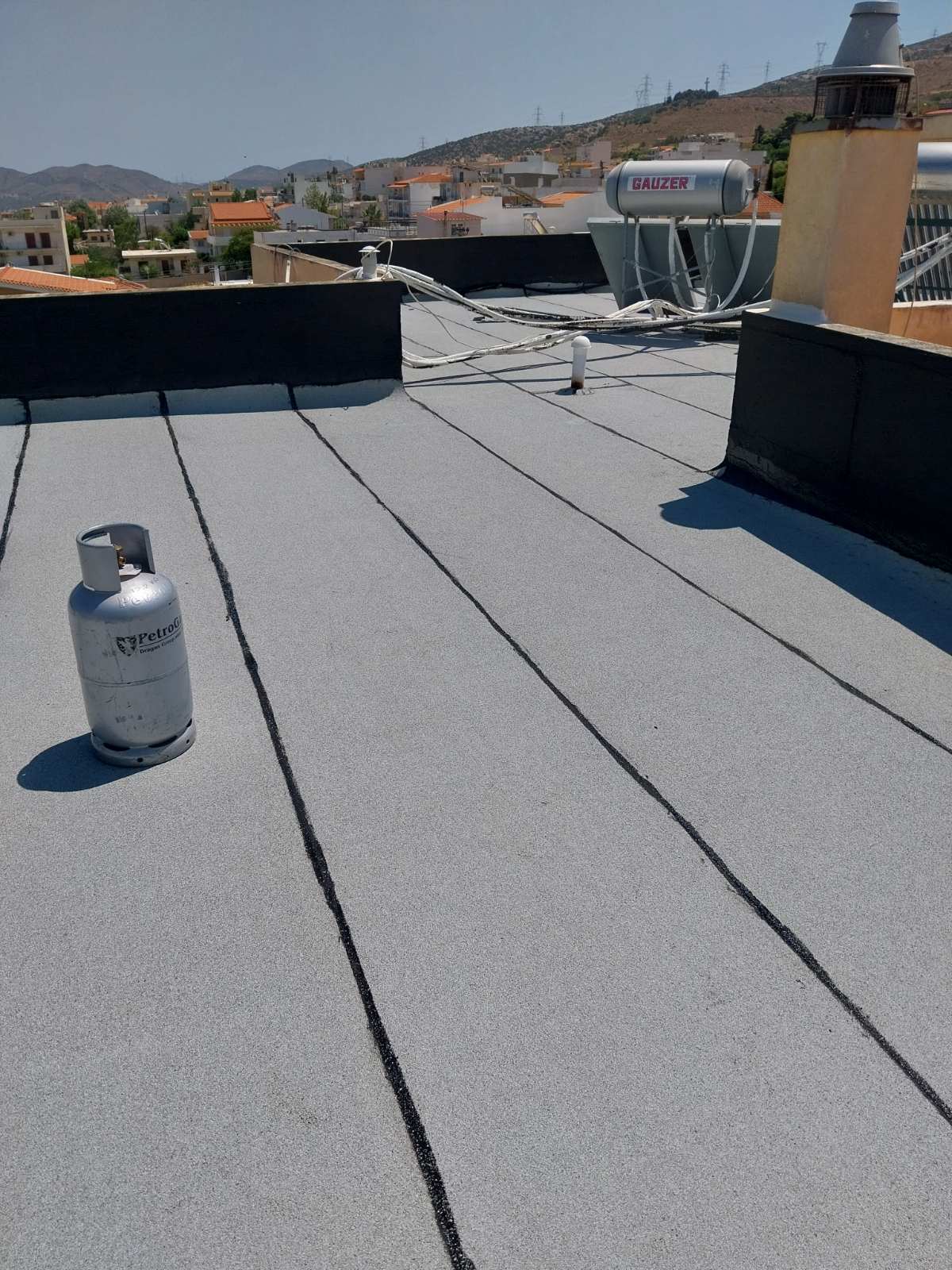
Photo: Μάριος-Μητσόγλου, CC BY-SA 4.0, via Wikimedia Commons. A roof waterproofing application in Athens. It is not a Singapore bathroom and not a product test.


How it works
- 1
Send photos of the stain and the wet room, the block, and whether the home is HDB, condo or landed.
- 2
We match a band already printed on HomeySG, or we say quote on inspection.
- 3
A hacked bathroom or a new membrane is named as V On Construction. A concealed supply pipe is named as a PUB licensed plumber.
- 4
You confirm the scope before anyone comes. Curtains, blinds and roller shades stay off the booking.
What is actually leaking
Last updated 31 October 2026. Prices below are bands already printed on HomeySG. This page is not legal advice.
Membranes fail in the details, not in the middle of a brochure. The middle of a floor is easy. The internal corner, the floor trap, the pipe that was installed after the membrane, and the upturn that stops 40mm short of the splash are where Singapore bathrooms leak. HDB’s building-works guideline is unusually concrete about this. In a bathroom or toilet, pre-packed waterproofing screed and a membrane go on before new floor finishes. The membrane turns up at least 150mm at walls, kerbs and pipes. A UPVC floor-trap grating with a long collar is part of the same job. Total finishes and screed stay within 50mm. You and the contractor water-test the bathroom when the finishes are done. Any system that cannot do those four things is the wrong system for an HDB toilet, however modern the tin looks.
Cementitious membrane is a polymer-modified cement, brushed or trowelled, often in two coats of different colours so a holiday shows. It likes a clean, damp-but-not-shining substrate. It does not like dust, tile adhesive left in ridges, or a coat so thick it cracks as it shrinks. Flexible grades take the small movement of a bathroom. They are a poor UV roof. Left exposed on a balcony in the west sun they chalk and crack. Under tile, in a room that never sees sun, they are the ordinary correct choice. A rigid cement slurry with no polymer is cheaper and less able to bridge a hairline. Do not let a quotation say “cementitious” without saying whether it is the flexible grade and how the upturn is reinforced at the corner with a tape or a bandage. The corner is the leak.
Liquid polyurethane is a different animal. It cures to a rubbery film and it bridges movement better than a basic cement coat, which is why it shows up on balconies, roofs and planter boxes in product literature. It fails when it is applied onto a damp screed: it skins, and the vapour blows a blister the next hot afternoon. It fails when one thick coat is used instead of the two thinner coats the tin describes. It fails in UV if the grade was an interior grade. A PU “injection” is not this coating. Injection pushes resin into a crack. It does not give you a 150mm upturn across a floor. People search both and get one contractor who does both words. Ask which one is on the invoice.
Bituminous torch-on is a sheet of modified bitumen, heated and stuck, lapped at the joints. It is a roof and basement material. It is thick, it smells, it does not want to turn into a 50mm bathroom floor build-up, and it is miserable around a forest of bathroom pipes. A cold lap, where the torch did not melt the underside, is a designed leak. Self-adhesive bitumen avoids the torch and still needs a lap you can trust and a substrate that is dry. Using torch-on in an HDB toilet because a roofer is the contractor on site is how a bathroom gets a roof system it cannot detail. The reverse mistake is brushing a bathroom cement coating across a flat roof and calling it done. The roof moves, the sun hits it, and the coating was never that product.
Sheet membranes, PVC and TPO among them, are welded. The weld is the whole system. A glued overlap that looks like a weld will open. They suit roofs and, in some builds, a wet area where the sheet can be dressed to a clamping drain. They are a poor casual overlay on an old HDB bathroom full of pipes you cannot move. Fully bonded sheets are sold for basements and “white tank” work. That is a structural waterproofing conversation, not a regrout. Crystalline treatments grow in concrete capillaries and are sold for the inside face of a leaking wall or a lift pit. They are not a shower membrane and they do not turn up a pipe. An over-tile clear coating is a wearing coat on the glaze. The no-hack page explains the limit: if a pond wets the ceiling below, the clear coat is on the wrong side of the tile.
Open balconies are the trap for people who have just learned the bathroom rule. HDB says an open balcony and a kitchen take pre-packed waterproofing screed under new finishes, and the membrane upturn of 150mm is required only around the sanitary stack, over a 400mm radius. Copying the full bathroom membrane onto the balcony is not what that sentence says. Ignoring the stack because “it is only 400mm” is how the ceiling under the stack stains. Roofs, planter boxes and window frames are the other pages. A window is not a membrane problem. Interior reseal is S$180 to S$380 a window, and exterior rivets stay with a BCA approved window contractor.
Homey Furnishing Pte. Ltd. (ACRA UEN 202018148K), 27 Mandai Estate, #06-10 Innovation Place, Singapore 729931, invoices permit-exempt leak checks, regrouting, silicone, and making-good after the water has stopped. V On Construction Pte. Ltd. (ACRA UEN 201611708H), on the HDB Directory of Renovation Contractors, invoices an HDB renovation permit when bathroom finishes are hacked or a new membrane is laid under new tiles. A concealed or new water-supply pipe is a PUB licensed plumber. Homey Furnishing is not that plumber and does not publish a waterproofing warranty term.
Curtains, blinds and roller shades are not part of this booking. Fabric window treatments are a different product, and these pages do not quote them.
How to read the symptom
Choose in this order. The product tin is last.
- Name the place: internal bath, open balcony, planter, roof, or a wall that is wet from outside.
- Ask whether the surface will be tiled, exposed to sun, or buried in soil. The answer deletes half the products.
- Count the penetrations: trap, pipes, outlet, railing posts. The quotation should have a sentence for each.
- Ask when the water test happens, and who looks at the ceiling or the room below.
- Reject a warranty stated in years unless it is written, and do not expect HomeySG to supply one. We do not print one.
| What you see | What it usually means | Stop |
|---|---|---|
| Internal bathroom, tiles coming up | Flexible cementitious, 150mm upturn | Do not torch a bitumen sheet into a 50mm build-up |
| Open HDB balcony | Screed plus the 400mm stack detail | Do not assume a full-floor membrane is what HDB asked for |
| Exposed roof, laps open | New sheet or torch-on, upstands included | Do not maintain an open lap with acrylic |
| Glaze intact, ceiling already wet | Not a coating problem | Open the finishes or stop |
HDB, condo and landed
The chemistry does not change between an HDB flat and a landed house. The permission and the exposure do.
| Question | HDB | Condo | Landed |
|---|---|---|---|
| Bathroom | 3-year ban on replacing finishes, then the 150mm detail and a permit contractor. | MCST may dictate the build-up and the noisy days. | No HDB permit. The same upturn is still good practice if there is a room below. |
| Balcony or roof | Balcony: 400mm stack rule. Block roof: town council, not your membrane. | Roof terraces are often common property. Ask. | Your roof. UV and outlets dominate. |
| Who signs | V On Construction if HDB needs a renovation permit. Homey Furnishing does not sign that permit and does not warrant a membrane in years. | Same split, plus the MCST form. | A structural tanking job can be a specialist. We will say so rather than stretch a bathroom sentence. |
Where each system actually fails
Cementitious fails at a dry, dusty corner and at a pipe that was poked through after the coat. You see it as a stain downstairs in a neat circle around the stack, while the middle of the ceiling stays clean. Polyurethane fails as blisters the size of a palm when the screed was damp, or as a chalked film on a west balcony. Bitumen fails as a cold lap you can lift with a fingernail, usually at the parapet where the torch was awkward. Sheet membrane fails as a weld that was never welded, often next to a post. Crystalline fails the homeowner’s expectation: the wall still looks damp for a while because the product is in the concrete, not a paint, and it never was going to fix the outlet on the roof.
A good specification names the product, the number of coats or the sheet thickness, the reinforcement at corners, the drain flange, and the test. A sloppy specification says “waterproofing inclusive” under a tile line. That phrase has paid for a single coat stopped at the skirting more often than it has paid for a 150mm upturn. Ask to see the upturn before the tile hides it. Once the tile is down, you are trusting a photograph.
Price, without a per-square-metre fiction
HomeySG does not print a rate per square metre for any of these membranes. The full bathroom hack and re-tile, membrane included, is S$4,000 to S$7,000 on the hollow-tile guide. That is a bathroom, not a roof and not a planter. Regrout at S$400 to S$900 is the joint, not the membrane. Everything else on this page is quote on inspection. Competitor pages in a Singapore search will show other numbers. Those are their advertisements. They are not our bands, and they are not a reason to invent a matching figure.
Which membrane fits
Use the place and the exposure. Brand names are a later argument with the person who will sign the tin.
| Place | System that fits | System that usually does not |
|---|---|---|
| HDB or condo bathroom under tile | Flexible cementitious, 150mm upturn, bandage at corners | Torch-on bitumen, exposed PU, clear coat if the pond already fails |
| Open HDB balcony | Pre-packed screed, membrane at the stack for 400mm | A full bathroom copy, or silicone over the scupper |
| Planter | Sheet or liquid dressed into the outlet, root barrier if the planting needs it | Paint above the soil line |
| Flat RC roof | Sheet or torch-on with upstands, or a coat only if the sheet is sound | Bathroom cement slurry as the only layer |
| Inside face of a wet concrete wall | Crystalline only after the outside source is found | As the first and only repair on an HDB facade |
Questions to ask before you pay
If they cannot point at the corner and the trap, they do not have a system. They have a tin.
- What is the product, and is it cementitious, liquid PU, torch-on, or a welded sheet?
- How is the corner reinforced, and how high is the upturn?
- What is the floor-trap or roof-outlet detail?
- When do I see the membrane, and when is the water test?
- Is any of this the S$4,000 to S$7,000 bathroom sentence, or quote on inspection?
- What written warranty are you offering? HomeySG is not offering a year count.
When to stop and call the building
A failed bathroom membrane that is wetting a neighbour is the HDB inspection guide if you cannot agree, and the waterproofing service page for the work itself once hacking is allowed. Do not start the hack inside the 3-year finish ban.
A block roof or an external wall is the town council. A window is the window sealant page. SCDF’s shelter rules still forbid hacking the shelter because a membrane detail would be easier if the wall were thinner.
How you're charged
How you're charged
A leak or waterproofing job that already has a sentence on HomeySG uses that sentence. Nothing in this table is a fuel surcharge, and the handyman hour is not added on top of a band unless the written scope says so. A membrane, a balcony, a planter, a roof, an epoxy-grout system, or a listening survey with no matching row is quote on inspection.
| Charge | What it covers | 2026 |
|---|---|---|
| Published band | The photo matches a row already on HomeySG | That row |
| Typical HDB bathroom regrout | The tile-page sentence, when the bathroom is that size | S$400 to S$900 |
| Hollow-tile injection, 4 to 10 intact tiles | Through the grout, tiles stay down | S$350 to S$750 |
| One mouldy silicone zone | Cut out and reseal, not a membrane | S$80 to S$150 |
| Meter and isolation test | The leak-guide sentence | S$140 to S$220 |
| Hairline or water-stain repaint | Only after the leak has stopped | S$150 to S$400 |
| Full bathroom hack and re-tile | Permit works, membrane included, on the hollow-tile guide | S$4,000 to S$7,000 |
| Balcony, planter, roof, epoxy system, or a membrane with no row | No catalogue sentence for that build-up | quote on inspection |
Who may do the work
Who is allowed to do the work
HDB’s renovation pages split a coat of silicone from a hacked bathroom. Replacing toilet wall and floor finishes is not allowed for 3 years from the completion date of the block, because a membrane sits on the screed. After that, a replacement uses pre-packed waterproofing screed, a membrane upturned at least 150mm at walls, kerbs and pipes, a UPVC floor-trap grating with a long collar, and a water test. Fines for unauthorised work are already written on the permit guide as up to S$5,000. Homey Furnishing does not sign the permit invoice.
- Regrout, a silicone zone, hollow-tile injection and a stain repaint after the water has stopped stay on the published rows. They do not replace a membrane.
- Opening the bathroom floor or wall finishes is V On Construction when the flat is HDB and the work needs a permit.
- PUB’s leak leaflet says it is an offence under the Public Utilities Act to engage an unlicensed worker for plumbing work. A concealed or new supply pipe is a licensed plumber. An exposed trap is a different visit.
- External walls of an HDB block are common property. The town council on the S&CC bill is the first report, not a private injector.
- SCDF does not allow hacking of household-shelter walls, floor slabs or ceiling slabs to chase a pipe. The leak is found another way.
- A window-frame leak is the window sealant page. Exterior rivets and stays stay with a BCA approved window contractor.
- Curtains, blinds and roller shades are not quoted here.
Ways to keep the bill smaller
Ways to keep the bill smaller
- Photograph the stain, the wet room, and the water meter before anyone hacks. A hack that destroys the evidence is a second problem.
- Run one test at a time. Shower, flush, aircon and rain on the same afternoon make a useless log.
- If the joint is only mouldy silicone, the published zone is S$80 to S$150. That is not a membrane.
- If the ceiling is already dry and the source is fixed, the hairline repaint is S$150 to S$400. Paint on a live leak is how the stain returns.
- Ask for two colours of cementitious coat, or a photo of every lap, before the tiles or the screed cover the work. The photo is the only record you will have.
WhatsApp the photos to +65 8561 0630.
Price, or quote on inspection
One published bathroom sentence includes a membrane. The rest of this guide is a way to brief a quote, not a rate card.
Anything not in that table is quote on inspection.
| Scope already published, or not | 2026 band in the repo | Where it lives |
|---|---|---|
| Full bathroom hack and re-tile, membrane included | S$4,000 to S$7,000 | Hollow-tile guide |
| Regrout, not a membrane | S$400 to S$900 | Tile repair |
| Balcony, planter, roof, or any other system | quote on inspection | No per-square-metre band |
| Interior window reseal | S$180 to S$380 | Window page, not a membrane |
WhatsApp the photos to +65 8561 0630. The reply uses a band already printed on HomeySG, or it says quote on inspection.
Official pages, not a legal opinion
HDB’s dimensions are the specification we are willing to repeat. We are not certifying a brand, and this is not advice on a dispute.
- HDB building works. 150mm upturn, 400mm balcony stack zone, 50mm thickness, long-collar trap.
- HDB renovation information. Water test after bathroom floor finishes are replaced. Three-year restriction on replacing toilet finishes.
- HDB ceiling leaks. Common property, including external leaks, goes to the town council.
- SCDF shelter clause 7.2. Shelter structure is not a place to thin a wall for a membrane detail.
Related pages
Frequently Asked Questions
What is the best waterproofing membrane for a shower?
Under tile, in an internal bathroom, a flexible cementitious membrane on pre-packed waterproofing screed, turned up at least 150mm and water-tested, is the system HDB’s guideline is pointing at. Torch-on bitumen and a clear coat on the glaze are for other places, or for no place, if the ceiling below is already wet.
How long is the warranty for waterproofing?
HomeySG does not publish one. HDB publishes a 1-year defects period for new flats from key collection, and a 3-year restriction on replacing toilet finishes from the block’s completion. Those are not a workmanship warranty for a membrane you buy privately. Get any year count from the contractor in writing.
How much is waterproofing per square metre in Singapore?
We do not print a per-square-metre price. A full bathroom hack and re-tile with the membrane is S$4,000 to S$7,000. Roofs, balconies and planters are quote on inspection.
What is the best waterproofing?
The system that matches the exposure and can be detailed at the pipe and the corner. Cementitious under a bathroom tile. Sheet or torch-on on a tired roof. A 400mm stack detail on an HDB open balcony. There is no best tin.
Is polyurethane better than cementitious waterproofing?
PU moves more and hates a damp substrate and the wrong UV exposure. Cementitious is the usual under-tile bathroom system and a weak exposed roof. Better is the one that survives the place you are putting it.
Can I use roofing bitumen in a bathroom?
It is a poor fit. Bathrooms need a thin build-up, a 150mm upturn and a long-collar trap inside a 50mm total. Torch-on is thick and unhappy around a cluster of pipes. Keep it on the roof.