

How shop signs are fixed and powered
The fixing is chosen from the wall and the weight. The power is chosen from whether a cable already exists. A new cable is an EMA licensed electrician. The sign itself is quote on inspection.


trusted by 500+
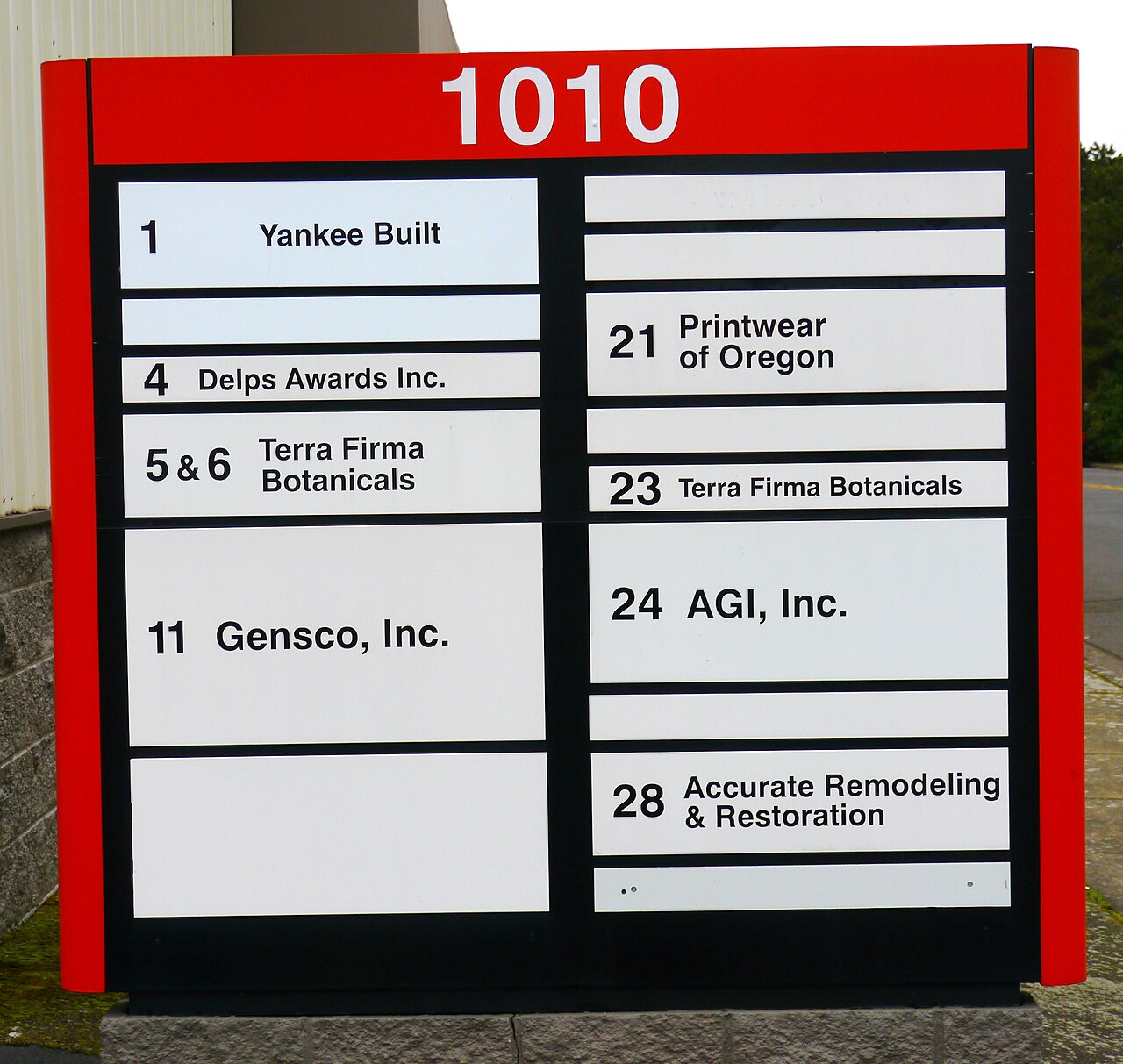
Photo: Rick Obst, CC BY 2.0, via Wikimedia Commons. A tenant directory in Eugene, Oregon. It is not a Singapore lobby and not a changeable-insert price.


How it works
- 1
Identify what is behind the paint: concrete, brick, block, steel or a lining on studs.
- 2
Match the anchor to that material and to the sign’s weight. Adhesive is not the anchor.
- 3
Keep the shutter guide, the exit sign and the common soffit out of the screw line.
- 4
If a new mains cable is required, stop and book an EMA licensed electrician before the face is closed.
What this job is
Last updated 31 October 2026.
People ask how a sign is actually held up, and who is allowed to wire an illuminated one. The answers are ordinary building practice plus two Singapore limits: the sign still has to sit where URA, HDB or the landlord allows, and the mains, when it is new, is an EMA licensed electrician. This guide is the physical half. The approval guide is the paper. Neither guide publishes a sign price. Fabrication is quote on inspection from a maker. Mounting is quote on inspection from the wall.
The directory in the photograph is a wall-fixed board in another country. It shows the idea of a sign on a facade. It does not show a Singapore anchor schedule. Do not copy a stud layout from a picture.
Good installation is quiet. The sign does not sway, the shutter still travels, the exit sign is still the brightest thing in its line of sight, and a later person can open the driver without destroying the face. Sloppy installation is plugs in plasterboard, a screw in the shutter guide, silicone where a drain should be, and a trailing lead in the ceiling. The rest of this page is how to tell those apart before you pay.
Curtains, blinds and roller shades are not part of this booking.
How the work is done
Concrete and solid clay brick are the straightforward substrates. The anchor is a mechanical anchor or a resin stud at the diameter and embedment the anchor’s data requires for the load, and a projecting sign loads the top anchors in tension, not only in shear. Holes are drilled to the diameter specified, dust is blown out for a resin system, and the fixture is not loaded before the resin’s cure. Good work marks the holes from the actual bracket, levelled, not from a sketch that was mirrored. Sloppy work drills into the cover of a reinforcement bar and then moves 20 mm without telling anyone, or uses a plastic plug in a 20 kg lightbox. We stop if the only available concrete is a thin architectural fin that was not meant to take a sign. BCA’s general note is that building works which are not insignificant need a qualified person. A new steel goalpost bolted to a facade is that conversation. A bracket into an existing beam often is not. We say which one the photo suggests, and we do not stamp an engineer’s drawing.
Hollow block and plasterboard are the substrates that fail. A hollow block needs a sleeve or a toggle designed for hollow materials, and even then a heavy tray is the wrong object. Plasterboard on studs will hold a small room sign if the screw hits a stud. It will not hold a lightbox, a stainless word or a directory that people lean on. The repair is to open the lining, fix plywood or cement board to the studs, and anchor to that sheet, or to lag a metal raceway through the lining into the studs. The raceway is also where a lit letter hides its cable. A French cleat does the same job for a panel that must come off at the end of the lease. Chemical anchors squirted into an empty cavity without a sleeve are the fixing that spins. Double-sided tape and construction adhesive are a seal after the mechanical fixing exists. They are the entire fixing only on the jobs that come back as loose letters. The repair page refuses to glue a letter back into the hole that already failed.
Steel shopfronts are a third case. The structure is the mild-steel angle or the RHS behind the aluminium cladding. Screws into the cladding alone are into a skin. The shutter guide, the hood and the barrel are not structure. A screw there makes the curtain rub, which becomes a shutter repair rather than a sign. Find the steel with a layout from the shopfront drawing if you have it, or by opening a cladding joint the landlord allows, not by a scatter of test holes across the fascia. On a conserved shophouse the problem is stricter. URA’s page puts the sign in the transom or in the other positions it draws, and it tells you not to damage plaster reliefs or the date stone. A raceway across a frieze because the cable was easier is the fixing that the guideline exists to stop. Five-foot-way signs need the headroom in the guideline that applies: 2,500 mm to the underside on URA’s conservation hanging-sign note, and not less than 2.5 metres above a verandah-way or footpath on BCA’s supporting page. HDB shops add 2.60 metres. Measure to the underside of the sign, not to the bracket.
Glass is not a masonry anchor. Window vinyl is film, described on the vinyl page, applied to clean glass with a plastic blade. A lightbox is not bolted through a glass fin. If a designer has drawn a projecting sign on a glass shopfront, the load has to go back to the head and the mullions the glazier designed for a load, or the sign does not go there. We do not drill a patch fitting that is holding the glass.
| What you should see at the end | What a sloppy visit leaves | Why it matters |
|---|---|---|
| Anchors match the substrate and the weight | Plastic plugs in board for a metal tray | The tray comes down |
| Shutter path untouched | A screw in the guide | The curtain rubs |
| Raceway or cleat so the word can leave | Twenty studs in someone else’s stone | Yield-up is a row of scars |
| Underside height measured | Height measured to the bracket | People duck, or the rule is missed |
How to scope it
Ask the maker for a weight and a bracket drawing before you argue about anchors. A 2 metre acrylic word and a 2 metre stainless word are not the same load. Ask whether the letters are individual studs or a raceway. Count fixings from that, not from the number of letters alone. On site, the scope is the wall you can see plus the wall you uncover. If uncovering it means hacking a structural member, that is V On Construction’s side of the invoice, the HDB renovation-contractor work, not a permit-exempt sign screw. Homey Furnishing’s side is the permit-exempt visit. Two invoices are normal. One blended price that hides which company is doing the hack is the quote to walk away from.
A sectional drawing of the fixing is also one of the documents BCA lists for a licence. The drawing and the holes should be the same drawing. Arriving with a different bracket from the one in ALS is how a lawful application becomes an unlawful sign.
| What you see | What to photograph | Stop |
|---|---|---|
| Concrete beam, weight known, bracket matches the ALS section | Anchor size | Quote on inspection for the hang |
| Plasterboard logo wall | Stud layout | Backer or raceway, or refuse |
| Only the shutter guide offers a bite | Stop | Do not use it |
| Conserved ornament behind the proposed raceway | URA positions | Move the sign or do not mount |
| Glass fin drawn as the support | The glazing | Load must go to a frame designed for it |
Which job you actually have
Pick the anchor from the wall. Do not pick the wall from the anchor you brought.
| Situation | Use this | Leave this alone |
|---|---|---|
| Solid concrete or brick | Mechanical or resin anchor at the specified embedment | A plug |
| Steel bulkhead | Into the steel, not the cladding | The shutter guide |
| Stud wall | Backer or raceway into studs | Plasterboard plugs |
| Hollow block | A hollow-rated anchor, and only for a light sign | Resin into an empty core |
| Glass | Film, or a frame that was designed for the load | A bolt through the pane |
| Unknown | Open it or refuse it | A longer screw |
Questions a business should ask
Questions a business should ask
Questions to ask any fitter who says the wall is fine.
- What is the substrate, and how do you know?
- What does the sign weigh, and are the top anchors in tension?
- Does the bracket match the section in the licence drawing?
- Will any screw meet a shutter guide, a smoke curtain or a sprinkler?
- If the wall is lined, where are the studs?
- What is the underside height above the floor people walk on?
- How will this come off at the end of the lease?
Power, after the sign can actually hang
A perfect bracket with a dangerous cable is not a finished sign.
| Supply | Who | Band if it matches | We will not |
|---|---|---|---|
| Existing isolator, tray dead when switched | Like-for-like driver or module, quote on inspection | Not the circuit band | Work live |
| New cable from the board | EMA licensed electrician | S$220 to S$450 for a dedicated circuit | Call it a handyman hour |
| Only a corridor light that the Town Council owns | Do not tap it | No band | Share the common lighting |
| No isolator and a wet tray | Stop | No band for working wet | Open it to have a look |
What is inside an illuminated sign
A lightbox is a tray, a face, LED modules and a driver. The modules are low voltage. The driver is the part that touches the mains. It has to sit where its heat can leave and where the next person can replace it without breaking the face. A driver buried behind the modules is the sloppy one. Modules must match the driver voltage. A fluorescent ballast left in circuit during a conversion is the sloppy one. The tray needs a way for water to leave at the bottom. Silicone around the entire perimeter, including the bottom, makes a tank. The tide mark inside a face is that tank. Insects are solved with mesh, not by sealing the drain.
LED neon flex is a strip in a sleeve on a backing, with the same kind of driver. Glass neon is a tube and a transformer, and the transformer is heavier and is not tucked into a display where the public can reach it. Both can be built to stay lit. A programme that flashes or chases is a legal problem on ordinary streets, which the neon page covers. The wiring does not change that. A drip loop on an outdoor cable keeps water out of the driver. Bell wire across a wet five-foot way does not.
Isolation is a switch that cuts the supply, labelled, reachable without opening the tray. Unplugging a lead behind a display every night is not an isolator. If we cannot find that switch, an EMA licensed electrician finds or fits the means of isolation. The electrician guide is how to ask who holds the licence. Homey Furnishing coordinates. We do not describe the handyman visit as the electrical work.
Good installation and sloppy installation
Walk the finished sign as a stranger. Push the bottom of a projecting tray. It should not sway. Look along the letters. The stand-off should be even and the baseline level, levelled with a level rather than with a sloping soffit. Open and close the shutter. It should not tick against a screw. Read the exit sign from the corridor. Clause 8.1 says a bright non-exit sign must not sit in that line of sight. Look under a lightbox for a gap or a hole that lets water out, and for a driver you could change. Look at a directory and ask whether a name can change without a scraper.
The sloppy list is the same walk failed. Plugs in board. A packer of scrap timber visible from the walkway. A screw through the printed logo because the template was mirrored. A bracket in the shutter guide. A face bowed because the retainer is short of screws. A driver in the insulation. A cable taped in the bulkhead. Adhesive as the only fixing. A chasing border added because the module controller had the feature. Any one of those is a reason to stop the invoice, not a snag for next month. There is no published warranty period that makes a sloppy fixing acceptable for ninety days.
What this costs, and what it does not
The sign, the anchor set and the driver are quote on inspection. A small hole after a fixing comes out is S$150 to S$280 when it matches the patch sentence. A dedicated circuit is S$220 to S$450 when a new cable is actually that sentence, on the electrician’s invoice. A mall night is S$380 to S$650 when the mall wants permit-to-work admin and one hardware fix. Micro-reinstatement at the end of the lease is S$1,800 to S$4,500 when that scope matches. The S$45 hour and the S$55 single-task call-out are for permit-exempt tasks that already use those sentences. They are not a sign price with a different name.
BCA’s projection figures are not optional extras. A sign in a verandah-way or over a footpath is not less than 2.5 metres above that level. A sign projecting more than 3.75 metres but less than 5 metres above the street does not project more than 60 centimetres. At 5 metres or more above the street the projection limit on that page is 1.5 metres. A Permit To Use comes before the licence if the sign exceeds 10 square metres on an advertising structure, or the structure exceeds 10 square metres, or its highest point is 4 metres or more. Those tests are about the object you are fixing, which is why the weight and the height belong on the drawing.
Rules that apply
Fixings have to satisfy the wall and the guideline for the building. Conservation positions, HDB’s 600 mm and 2.60 m, BCA’s projection table, and a mall’s tenant zone can all apply at once. The strictest one that truly applies is the one you build to. We do not average them.
New mains work is an EMA licensed electrician. Hacking that is a renovation is V On Construction. Homey Furnishing invoices the permit-exempt visit. Exit signs stay on the SCDF standard. No response time and no warranty term are published for sign fixings.
Official pages
- BCA: sign projection rules, Permit To Use and licence fees
- URA: signs in conservation areas
- URA: five-foot-way sign headroom
- BCA: building works that do not need plan approval
- SCDF Fire Code 2023 clause 8.1: exit lighting and exit signs
Homey Furnishing Pte. Ltd. (ACRA UEN 202018148K), 27 Mandai Estate, #06-10 Innovation Place, Singapore 729931, invoices the permit-exempt visit. V On Construction Pte. Ltd. (ACRA UEN 201611708H), on the HDB Directory of Renovation Contractors, invoices hacking, a new layout, and an HDB renovation permit. Homey Furnishing is not a property agency, not a CEA practice, and not a MOM-licensed employment agency.
How you're charged
How you're charged
A job that already has a sentence on HomeySG uses that sentence. The hour is not added on top of a band unless the written scope says so. There is no fuel surcharge and no published night premium except the mall overnight row.
| Charge | What it covers | 2026 |
|---|---|---|
| Per hour | Permit-exempt handyman time after a priced task, if the scope says so | S$45/hr |
| Minimum, one task | One permit-exempt task on one visit | S$55 |
| Mall overnight | Permit-to-work admin and one hardware fix when the mall requires the night slot | S$380 to S$650 |
| A matching catalogue row | The photo matches a row already printed | That row |
| A term contract, a sign, a plain office closer, a mineral ceiling tile | No catalogue row for that product | quote on inspection |
Do not accept a single figure that blends fabrication, the BCA fee, the electrician and the fixing. Those are separate lines. Only the fixing is even possibly our quote, and it is quote on inspection.
Ways to keep the bill smaller
Ways to keep the bill smaller
- Pay for a raceway or a cleat on a short lease. Removal is then one box, not twenty holes.
- Put the driver where it can be changed. The second failure is cheaper than the first if the face survives it.
- Weigh the sign before you buy anchors. The wrong anchor is a second visit.
- Match the bracket to the licence drawing so you do not remake a lawful sign into an unlawful one.
WhatsApp the photos to +65 8561 0630.
Price, or quote on inspection
Published neighbours of a fixing visit. The fixing itself is not among them.
Anything not in that table is quote on inspection.
| Scope already published | 2026 band in the repo | Where it lives |
|---|---|---|
| The sign, letters, face, vinyl or neon | quote on inspection | No fabrication band and no mounting band |
| Small hole patch after a fixing comes out | S$150 to S$280 | Only when the photo matches that patch sentence |
| Dedicated circuit, when a new cable is required | S$220 to S$450 | DB page. An EMA licensed electrician does the cable |
| Mall overnight, permit-to-work admin and one hardware fix | S$380 to S$650 | Only when the mall’s ask matches that row |
| Micro-reinstatement at lease end | S$1,800 to S$4,500 | Reinstatement page, when the lease asks for that scope |
WhatsApp the photos to +65 8561 0630. The reply uses a band already printed on HomeySG, or it says quote on inspection.
Related pages
Frequently Asked Questions
How is a shop sign fixed to the wall?
Into concrete, solid brick or the steel of the bulkhead, with an anchor suited to the weight. A lined wall needs a backer or a raceway into the studs. Plasterboard plugs and shutter guides are refused.
Can you mount a lightbox on plasterboard?
No. The tray has to reach structure. A backer fixed to studs can carry letters. It is not an invitation to plug the board.
Who wires an illuminated sign?
An EMA licensed electrician if the cable is new. The dedicated-circuit band is S$220 to S$450 only when the work matches that sentence. An existing isolator is not a new circuit. We do not describe a handyman hour as the electrical work.
Why do lightbox faces stain from the inside?
Water sits in a tray whose bottom was sealed. The drain has to stay open, with mesh if insects are the worry. New LEDs do not fix a tank.
How high does the sign have to be?
BCA’s supporting page says not less than 2.5 metres above a verandah-way or footpath. URA’s conservation note says at least 2,500 mm under a five-foot-way hanging sign. HDB’s shop page says at least 2.60 metres. Measure to the underside. Use the rule that applies.
What does a sloppy sign installation look like?
Plugs in board, a screw in the shutter guide, a swaying tray, a driver you cannot reach, silicone where the drain should be, and a flashing programme on a street where BCA prohibits it.
Do you fabricate the bracket or the sign?
Fabrication is quote on inspection from a maker. This guide is the fixing and the power. We mount, remove and repair.