

The food shop owns the grease trap and keeps it under 300 mg/L
Food shops that discharge to the public sewer have a grease trap unless PUB has allowed a no-cook, no-dine exception. The occupier maintains it. Trade effluent must not carry non-hydrocarbon grease and oil above 300 mg/L. A pump-out matching the exhaust page is S$350 to S$680.


trusted by 500+
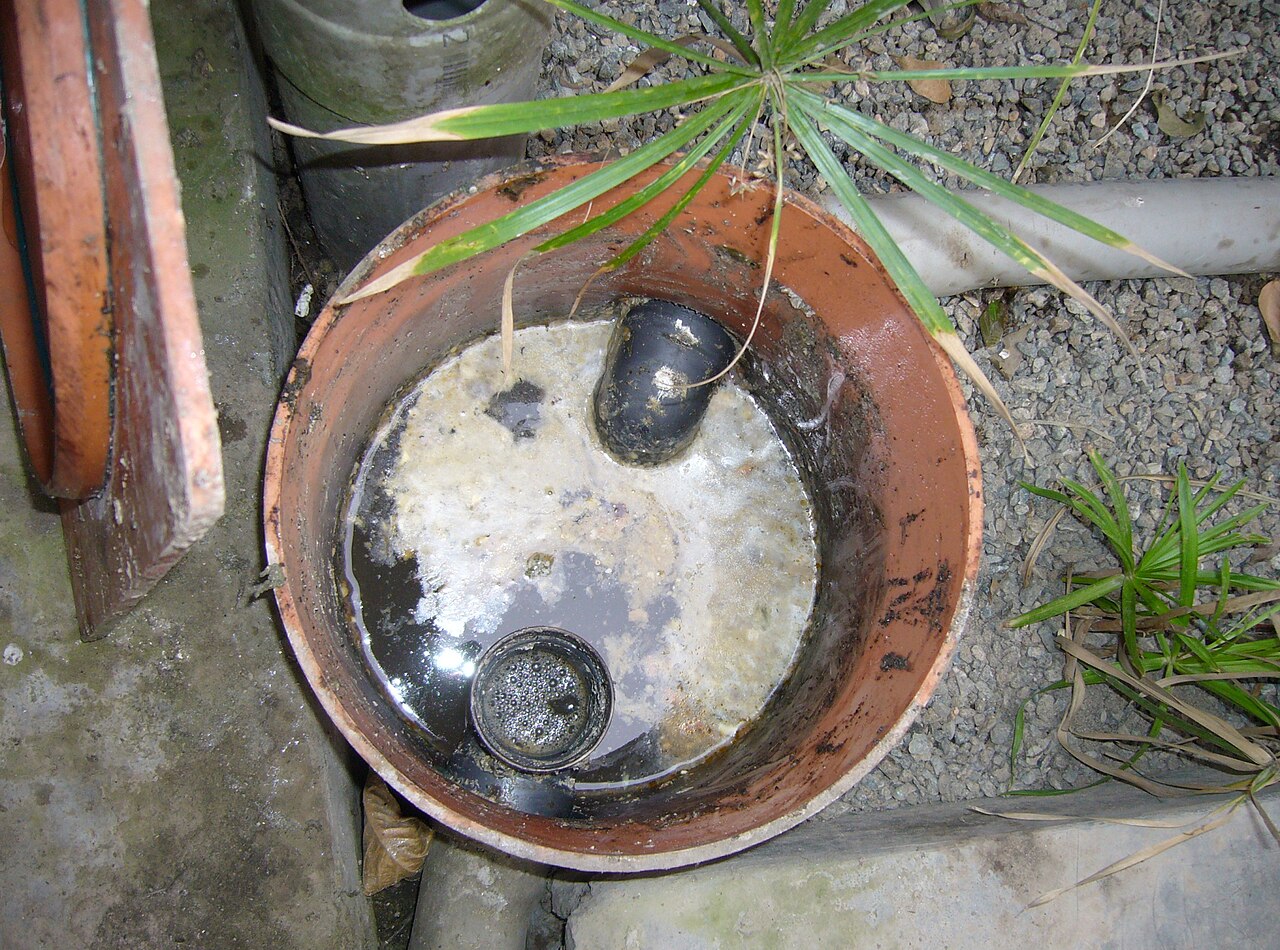
Photo: Sustainable Sanitation Alliance, CC BY 2.0, via Wikimedia Commons. An opened grease trap. It is not a Singapore food shop and not a PUB sample result.


How it works
- 1
Identify the legal duty before you ask for a price.
- 2
Use a printed band only when the job is the one that band describes.
- 3
Name the licensed party. We do not issue the certificate, the pump docket’s waste licence, or a vector-control licence.
- 4
Confirm the scope. This page is the rule. The service page is the visit.
What this job is
Last updated 31 October 2026.
A food shop’s grease problem arrives as a smell, a slow floor trap, or a letter. The fitting that answers it is not the bottle trap under the sink and not the bathroom auger at S$120 to S$240. It is the grease trap: the chamber that lets kitchen water cool and the fat separate, which is the definition in the Sewerage and Drainage (Trade Effluent) Regulations. Regulation 6 says a person who discharges trade effluent installs a grease trap where the codes of practice require one, and maintains it as the Board requires by written notice.
The number people misquote is the concentration. Regulation 10 says trade effluent must not be discharged into the public sewerage system with grease and oil, which is not hydrocarbon in nature, greater than 300 milligrams per litre. That is the text as amended, with the commencement notes on Singapore Statutes Online. It is not 100 mg/L, and it is not a target to sail close to. The trap, sized and emptied properly, is how a shop stays under the limit. A 1,000-gallon price that shows up in overseas answers is not a Singapore row.
PUB’s used-water FAQ is plain about ownership. Kitchens where food is prepared, cooked or served need a trap or interceptor. The eatery installs, owns and maintains it, and checks that it is sound and not a public hazard. Non-cooking outlets with little grease may be excused with PUB’s permission. The same FAQ says NEA’s layout is cleared before Form F is sent to PUB, because the trap also has to satisfy NEA’s environmental-health code. We do not submit Form F and we do not give that permission.
Curtains, blinds and roller shades are not part of this booking. A roller shutter is a different product and stays on the shutter page.
How the work is done
The March 2025 Code of Practice on Sewerage and Sanitary Works, section 4.2.2, is the layout. Food shops and food processing establishments have traps so that non-hydrocarbon oil and grease stay within the regulations. Sinks and floor traps in the preparation area discharge on their own pipes to the trap. Toilets do not connect to it. Standard circular traps follow PUB’s drawings. Non-standard traps comply with BS EN 1825 or ASME A112.14.3. Portable interceptors inside the shop are allowed only where URA has approved a change of use and a standard trap is not feasible, and they still have to be reachable for cleaning. Every trap, standard or not, is sited so an NEA-licensed general waste collector can clean it. Sizing uses the nominal-size method in the code. We do not pick a nominal size from a photograph of a menu.
Pumping, when it matches the exhaust page, is S$350 to S$680 for an under-sink or floor grease trap: fat removed, gasket checked, a bio-enzyme dose. The hood and filters are S$450 to S$850. The full duct and fan, with photos, are S$750 to S$1,850, which is the visit tied to SCDF Fire Code clause 7.1.2 on that page. The waste leaves with a licensed general waste collector. It does not go into a refuse chute, a floor waste or a storm drain. A “plumber” who scoops the chamber into a bag and leaves is not that row.
HDB’s shop guide adds a landlord layer for an eating house, food court or takeaway. The tenant pays to install the grease separator and the exhaust, and pays to maintain the traps, hoods and sewer pipes. Receipts are produced when HDB asks. The internal refreshment area is at least half the trading area, and the outdoor refreshment area is not bigger than the internal one. The exhaust gets smell control, silencers, and a wet-chemical fire suppression system. The entire hood and duct, inside and out, are degreased at least every 12 months, or more often if use is heavy, by an exhaust specialist, and the records are kept. A cakeshop submits the exhaust drawings with the rest of the renovation. Those are HDB’s prerequisites. They are not a second price list.
| What you should see at the end | What a sloppy visit leaves | Why it matters |
|---|---|---|
| The trap is accessible, the gasket seals, and the waste leaves with a collector | A lid buried under a false floor | The collector cannot pump what the collector cannot reach |
| Toilet waste is on a different pipe | A WC tied into the kitchen line | The code forbids that connection |
| The hood and the trap are both on the schedule | A shiny canopy and a full duct | Clause 7.1.2 on the exhaust page is about the duct, not only the filters |
| Receipts exist for an HDB eating house | A verbal “we pumped it” | HDB asks for the receipts |
How to scope it
Say whether food is cooked, whether anyone dines in, and when the trap was last opened. Photograph the lid and the path a collector would walk. If the smell is at the sink only, say so, because that may be the bottle trap. If the ceiling below is staining, say so, because that may be a leak rather than a full trap.
A new trap, a resized trap, or a change of use is Form F and a qualified layout, not a pump-out. Do not book the S$350 row for a trap that does not exist yet.
| What you see | What to photograph | Stop |
|---|---|---|
| The existing trap smells and the kitchen floor trap is slow | The lid and the last receipt | S$350 to S$680 if it is that pump-out |
| No cooking and no dine-in | PUB’s permission, if you have it | Do not assume you are exempt |
| A toilet was replumbed toward the kitchen | The waste pipes | Stop. That connection is not maintenance |
| The hood is the complaint | The filters and whether the duct has a panel | S$450 to S$1,850 by the scope on the exhaust page |
Which job you actually have
Match the chamber, then match the rule.
| Situation | Use this | Leave this alone |
|---|---|---|
| Pump-out of an existing trap as the exhaust page describes | S$350 to S$680 | Not a 1,000-gallon price |
| Hood and filters | S$450 to S$850 | Not included in the pump |
| Full duct and fan | S$750 to S$1,850 | An exhaust specialist’s record for an HDB eating house |
| New trap or a change of use | PUB Form F after NEA’s layout. Quote on inspection | Not a pump-out |
| Bathroom auger | S$120 to S$240 only for a bowl or a bathroom floor trap | Not this trap |
| Tap labour | S$55 | Not a grease line |
Questions a shop should ask
Questions a shop should ask
Ask who takes the waste and who signed the layout.
- Is food cooked or served here, or has PUB excused a non-cooking outlet?
- Where is the trap, and can a collector reach it?
- Does any toilet connect to it?
- When was it last pumped, and which licensed collector took the waste?
- Is the hood on the same visit, or only the trap?
- Is this an HDB eating house that must show receipts?
- Are you asking for a price per gallon? We will not give one.
- Is the trap missing? That is a design submission, not a clean.
Hawker stall, cafe, or an HDB eating house
The limit is the same. The landlord’s extra rules are not.
| Question | Cafe or restaurant | HDB eating house | Mall food unit |
|---|---|---|---|
| Who maintains | The operator | The tenant, and HDB can ask for receipts | The operator, plus the mall’s loading rules for the truck |
| Layout approval | NEA then PUB Form F for a new trap | Same, and the shop renovation guide | Same, plus the centre’s permit to work |
| Hood | At least the fire-code cleaning the exhaust page describes | At least every 12 months in HDB’s guide | Often at night. The handyman night row is not the vacuum truck |
| Price | S$350 to S$680 if the pump-out matches | Same row, plus the hood row if that is in scope | Same, if the photo matches |
What the other searches are really asking
“How often should you empty your grease trap?” has no single day-count in the regulation we read. The duty is to maintain it so the discharge stays within the limit, and as PUB requires by notice. A busy stall fills faster than a cafe that does not fry. HDB’s 12-month line is for the hood and duct of an eating house, not a claim that every trap can wait a year. If the chamber is solid, you waited too long. The exhaust page already says a neglected trap is a different job from a routine pump.
“How much does it cost to get a restaurant grease trap cleaned?” is the S$350 to S$680 row when the photo is that pump-out. A duct certificate is the S$750 to S$1,850 row. “How much does it cost to have someone clean my home?” is the wrong trade. Home cleaning prices are on the cleaning pages. They are not a grease trap.
“Do plumbers clean grease traps?” A new water point is a PUB licensed plumber. Pumping is the exhaust visit, with the waste going to a licensed collector. One person can hold more than one role. The invoice should still say which role you bought. A tee in a riser is not a pump.
Rules that apply
The regulations, the March 2025 code and PUB’s FAQ are the water rules. NEA’s code is why the layout goes to NEA before Form F. SFA’s food-shop checklist is the hygiene surface, not a substitute for the trap. SCDF clause 7.1.2 is why the duct is a fire load, priced on the exhaust page and not repeated as a new number here.
HDB’s shop guide is the landlord rule for its eating houses. A private landlord can be stricter. The 300 mg/L limit does not relax because the lease is silent.
Official pages
- Sewerage and Drainage (Trade Effluent) Regulations
- PUB Code of Practice on Sewerage and Sanitary Works, 3rd edition, March 2025
- PUB used-water FAQ on grease traps
- HDB renovation guide for shop tenants and owners, December 2025
- SFA food-shop licence checklist
Homey Furnishing Pte. Ltd. (ACRA UEN 202018148K), 27 Mandai Estate, #06-10 Innovation Place, Singapore 729931, invoices the permit-exempt visit. V On Construction Pte. Ltd. (ACRA UEN 201611708H), on the HDB Directory of Renovation Contractors, invoices hacking, a new layout, and an HDB renovation permit. Homey Furnishing is not a property agency, not a CEA practice, and not a vector-control operator.
How you're charged
How you're charged
A job that already has a sentence on HomeySG uses that sentence. The hour is not added on top of a band unless the written scope says so. There is no fuel surcharge and no published night premium except the mall overnight row. A shop does not inherit a flat’s price just because the fitting looks similar.
| Charge | What it covers | 2026 |
|---|---|---|
| Per hour | Permit-exempt handyman time after a priced task, if the scope says so | S$45/hr |
| Minimum, one task | One permit-exempt task on one visit | S$55 |
| Mall overnight | Permit-to-work admin and one hardware fix when the mall requires the night slot | S$380 to S$650 |
| A matching catalogue row | The photo matches a row already printed | That row |
| A gondola run, a cassette aircon, a full shop repaint, a camera, a floor trap size | No catalogue row for that product | quote on inspection |
The pump, the hood and the full system are three printed rows. A new trap is quote on inspection. No per-gallon price is added.
Ways to keep the bill smaller
Ways to keep the bill smaller
- Pump before the fat sets. The routine row is smaller than a solidified dig-out, and the exhaust page already separates them.
- Keep the lid reachable. Moving a fridge off the lid is cheaper than a second mobilisation.
- Keep toilet waste off the kitchen line. Reworking that connection is the costly version.
- File the collector’s receipt. An HDB eating house will be asked for it.
WhatsApp the photos to +65 8561 0630.
Price, or quote on inspection
These are the only grease figures in the catalogue.
Anything not in that table is quote on inspection.
| Scope already published | 2026 band in the repo | Where it lives |
|---|---|---|
| Grease-trap pump-out | S$350 to S$680 | Exhaust page |
| Hood, filters and trough | S$450 to S$850 | Exhaust page |
| Full duct, fan and photos | S$750 to S$1,850 | Exhaust page |
| Stainless, silicone and a grease-trap cover | S$320 to S$680 | F&B inspection page |
| Bathroom floor-trap auger | S$120 to S$240 | Not this trap |
| A new trap, or a price per gallon | quote on inspection | Not printed |
WhatsApp the photos to +65 8561 0630. The reply uses a band already printed on HomeySG, or it says quote on inspection.
Related pages
Frequently Asked Questions
How often should a grease trap be cleaned?
Often enough that the discharge stays within PUB’s limit, and as PUB requires by notice. There is no single day-count in the regulation for every shop. HDB’s 12-month line for an eating house is the hood and duct, not a promise that the trap can wait a year.
How much does it cost to get a restaurant grease trap cleaned?
An under-sink or floor grease trap pump-out, as the exhaust page describes it, is S$350 to S$680. The full duct system is S$750 to S$1,850. A 1,000-gallon price is not used.
Do plumbers clean grease traps?
A new water point is a PUB licensed plumber. The pump-out on this site is the exhaust page, and the waste goes to a licensed general waste collector. They are different lines on an invoice.
How much does a 1000 gallon grease trap cost?
That unit is not how this catalogue is written. No gallon price is published. Sizing of a new trap follows PUB’s nominal-size method and is quote on inspection.
Who is responsible for maintaining a grease trap?
PUB’s FAQ says the eatery owns and maintains it. In an HDB eating house the shop guide puts that cost on the tenant and asks for receipts.
Does a cafe with no cooking need a grease trap?
PUB’s code allows a shop with no cooking and no dine-in to go without one, subject to PUB’s permission. Do not assume the exception. A kitchen that prepares, cooks or serves food needs the trap.