

The shop keeps the extinguisher and the exit sign working
Fire Code clause 6.1 and SS 578 put portable extinguishers in buildings that are not dwellings, maintained and tagged. Clause 8.1 puts an exit sign over the exit and sets the lighting level. The occupier inspects. A certified workshop services the extinguisher. We do not sell that service and we do not certify the sign.


trusted by 500+
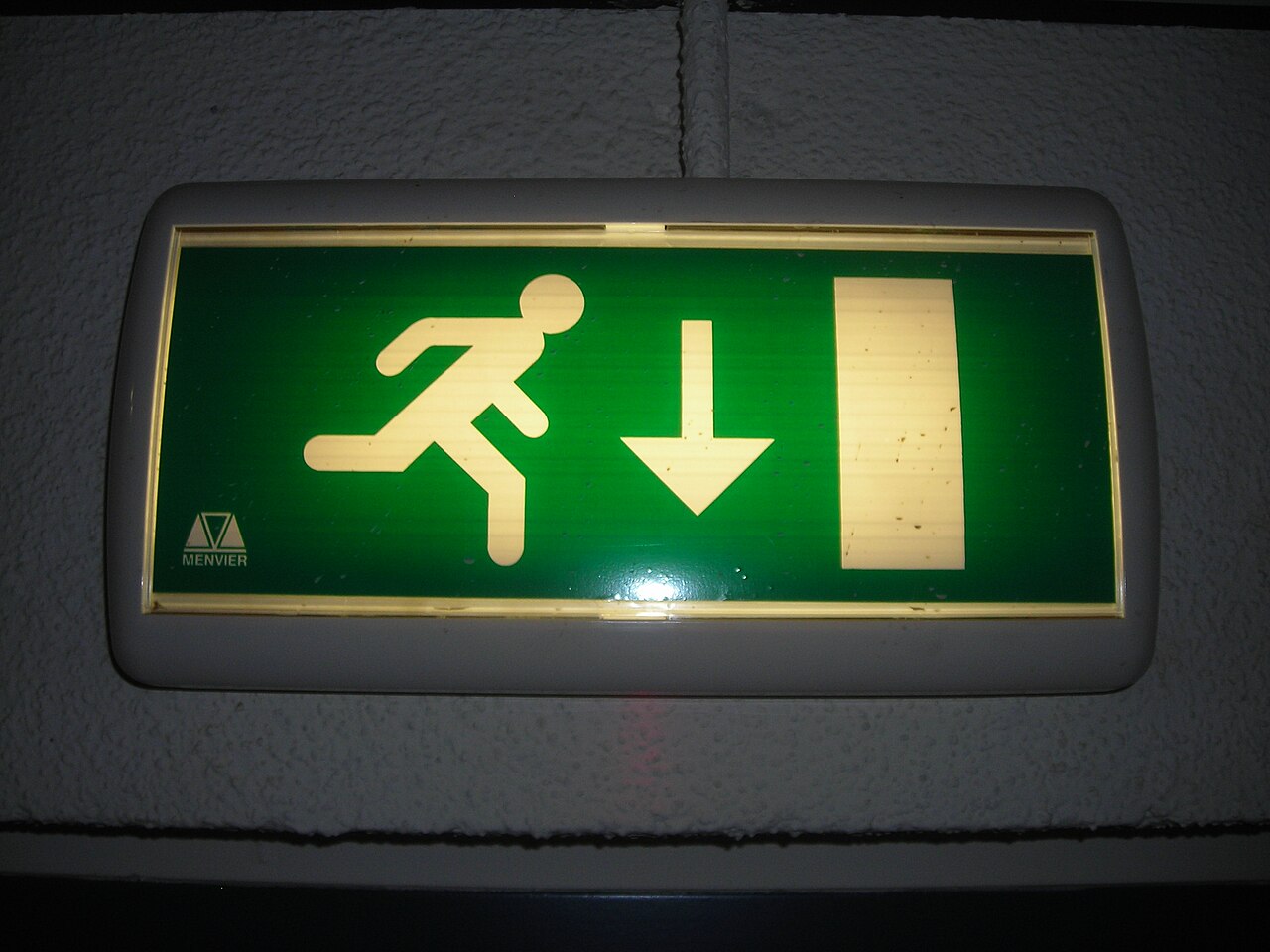
Photo: Erik1980, CC BY-SA 4.0, via Wikimedia Commons. An exit sign. It is not an SCDF certificate and not proof the battery was tested.


How it works
- 1
Identify the legal duty before you ask for a price.
- 2
Use a printed band only when the job is the one that band describes.
- 3
Name the licensed party. We do not issue the certificate, the pump docket’s waste licence, or a vector-control licence.
- 4
Confirm the scope. This page is the rule. The service page is the visit.
What this job is
Last updated 31 October 2026.
A shop’s fire gear fails in view of customers. The extinguisher sits behind a gondola. The gauge is in the red. The exit sign above the door is dark, and someone has stuck a promotion across it. Staff describe all of that as “the safety stuff”. The duties are split, and the split is the point of this page. Looking is the occupier’s job. Opening an extinguisher and putting a service label on it is a certified workshop’s job. Designing or moving the exit sign is a qualified person’s fire-safety submission. A handyman who swaps the sign for a track light, or who shakes an extinguisher and calls it serviced, has done the sloppy version of all three.
SCDF’s page on portable extinguishers says units that are required must be built to SS EN 3 and maintained, charged, tested and tagged to SS 578. The owner or occupier should inspect at least monthly: not obstructed, instructions legible and facing out, full when hefted or weighed, no obvious damage, corrosion, leak or clogged nozzle, gauge in the operable range. SCDF’s briefing on SS 578 adds the tamper seal and the next maintenance date on the service label. Maintenance, as distinct from that look, is at least yearly or when the inspection finds a fault, by a competent person of an approved organisation certified by the certification body SCDF names. From 1 January 2020 the serviced extinguisher carries that body’s control tag as well as the service label. SCDF’s own FAQ says it does not approve, endorse or recommend extinguisher products. A supplier who claims an SCDF endorsement is, in SCDF’s words, false and misleading.
HDB’s shop guide tells the tenant to maintain exit lighting, emergency lights, the manual fire alarm, hose reels and extinguishers to FSSD’s standard. That is a tenant duty in an HDB shop. It is not a contract with us. A mall handbook, such as Heartbeat@Bedok’s fit-out guide, tells tenants to keep extinguishing equipment, exit lighting and emergency lighting maintained. Again, that is the tenant’s duty. Our role on this page is to say which visit we will not pretend to do.
Curtains, blinds and roller shades are not part of this booking. A roller shutter is a different product and stays on the shutter page.
How the work is done
A monthly inspection is a walk, not a workshop. The person walks the path a customer walks. The extinguisher is where the plan put it, the sign is readable, the gauge is in range, the pin and seal are there, and a CO2 extinguisher is weighed rather than hefted if that is the only way to know it is full. SCDF says CO2 contents are checked by weighing. A record is kept when something is wrong, with the date and the initials. If the inspection finds damage or a failed gauge, the extinguisher goes for maintenance, and a unit of the same type and at least the same rating stands in while it is gone. We do not leave the hook empty. We also do not perform that maintenance. Homey Furnishing is not a certified extinguisher workshop and does not issue a control tag.
The exit sign is a different object from a shop spotlight. Clause 8.1.7 requires a sign over the entrance to every exit on every floor, clearly visible, and signs over exit-access doors of rooms with more than one door. Decorations, furnishings and equipment must not impair it, and a brightly lit sign that is not an exit sign must not sit in the line of vision. Where there is no engineered smoke control, the code wants at least 500 mm between the top of the exit sign and the soffit. Low-level signs, where they are used, do not replace the sign above the door. Exemptions exist for some small rooms. They are drawn in the code. A contractor who removes a sign because “the room is small” without reading the diagram is guessing.
Exit lighting is the light that stays on when the supply fails. Clause 8.1.1 points the illuminance and the spacing at SS 563, and the code’s explanation on that page is not less than 0.5 lux on the centre line of the escape route, at the floor, for at least one hour. In staircases and exit passageways the changeover must not interrupt the light for more than one second. Corridors and lobbies follow the same lighting rule. A battery pack has to be the type that stays charged and can run for that hour. Street lighting outside the shopfront does not count. A dark exit sign is not fixed by aiming a track light at the door. Replacing or relocating the sign is listed by SCDF as fire safety work that needs plan approval by a qualified person before the work. A failed lamp inside an existing sign, if the sign itself stays, is still not a decorative lamp price. It is quote on inspection, and only if a licensed electrical worker is content it is maintenance of the existing sign rather than a new installation. We will not certify the result.
| What you should see at the end | What a sloppy visit leaves | Why it matters |
|---|---|---|
| The monthly look is recorded and a faulty unit is swapped for an equal rating while it is serviced | An empty hook, or a gauge in the red ignored | The next person has nothing to use |
| The service label and the control tag are from a certified workshop | A handwritten “checked” sticker | SS 578’s label identifies the person and the organisation |
| The exit sign is visible from the aisle, with the gap the code wants | A gondola or a promotion across it | Clause 8.1.7 is about visibility |
| A relocated sign has a qualified person’s approval | The sign moved to suit a shelf | That move is fire safety work |
How to scope it
Photograph the extinguisher, the gauge, the label, and the view from the door to the sign. Say whether you want a monthly routine explained, or whether a workshop has already condemned a unit. We will not quote an annual service. Ask a company on the certification body’s list. If the sign is dark, say whether the fitting is still the approved sign or whether someone wants it moved.
Shelves, cameras and paint stop at the sign. The shelving page and the camera page both refuse to cover it. A patch that would bury a detector stops as well.
| What you see | What to photograph | Stop |
|---|---|---|
| The gauge is in range and the sign is lit | Keep the monthly record | Not a workshop visit |
| The gauge is down, the seal is gone, or the cylinder is damaged | A certified workshop, and a stand-in unit | Not a shake-and-sticker |
| The exit sign is dark but still in the right place | A licensed electrical worker if the fitting is being opened | Quote on inspection. Not a track light |
| Someone wants the sign moved for a shelf | A qualified person and SCDF | Not this handyman visit |
Which job you actually have
Split the look, the workshop, and the plan.
| Situation | Use this | Leave this alone |
|---|---|---|
| Monthly visual check | The occupier, against SS 578’s list | Not a priced Homey contract |
| Annual maintenance, recharge, or a control tag | Certified workshop | Not us |
| Extinguisher hidden by stock | Move the stock | Do not move the extinguisher off the escape path to suit a display |
| Dark exit sign in its existing position | Quote on inspection, licensed worker if the wiring is opened | No certification |
| Sign relocated or removed | Qualified person, plan approval | Not a merchandising decision |
| New decorative track | Lighting page | Does not satisfy clause 8.1 |
Questions a shop should ask
Questions a shop should ask
Ask who is allowed to sign the label.
- Is this a monthly look, or a unit that has already failed it?
- Who is the certified workshop, and will a same-rating unit stay on the hook?
- Is the exit sign blocked, dark, or being moved?
- Does the room actually fall under an exemption diagram, or is that a guess?
- Is a licensed electrical worker opening the sign?
- Will anyone certify the result? We will not.
- Does the quote claim an SCDF endorsement of a brand? SCDF says that claim is misleading.
- Is a shelf, a camera or a promotion in the line of sight?
A shop, a mall corridor, or a dwelling
Dwellings are the exception in clause 6.1. A shop is not a dwelling.
| Question | Shop or mall unit | HDB shop | Flat |
|---|---|---|---|
| Extinguisher | Required unless the building is a dwelling unit | Tenant maintains it to FSSD’s standard | Clause 6.1 excepts dwelling units. Do not copy the shop rule blindly into a flat |
| Exit sign | Over the exit, visible | Same, and the shop guide names exit lighting | Exemptions for purpose group I and II are in the code |
| Who services the cylinder | Certified workshop | Same | Same, if a cylinder is there |
| Our price | None for the service label | None | None |
What the monthly look actually includes
SS 578, as SCDF’s briefing summarises it, separates inspection from maintenance. Inspection is the visual check: correct location, not obstructed, service label showing the next date, label legible, tamper seal intact, gauge in range, fullness by weight, no physical damage. The occupier or a person they designate does that. Maintenance is a thorough examination of the extinguisher and its contents, at least once a year or sooner if the inspection failed. The workshop does not send a third party to stick the label on. The briefing says the approved organisation does not appoint someone else to inspect, maintain, recharge and issue the label on its behalf.
Hydrostatic test intervals are in the standard. A trade page will quote five years for powder, water and foam and ten years for gas types. Those intervals are the workshop’s, and they are not a price. If your label is silent, the workshop reads the standard. We will not guess a test date from a faded sticker and then sell a new cylinder.
Placement is along the way out, not beside the risk in a way that the fire makes the extinguisher unreachable. Clause 6.1 says special-risk extinguishers sit near the risk but not so near that the fire cuts them off. A deep-fryer extinguisher stored above the fryer fails that sentence. The operating instructions face outward, including inside a cabinet.
Rules that apply
The authorities are SCDF for the Fire Code and for the extinguisher page, and HDB where the shop guide copies the FSSD duty onto the tenant. SS 578 and SS EN 3 and SS 563 are the standards those pages name. We are not the certification body and not the workshop.
Electrical work inside an exit sign, if it is done at all, is an EMA licensed electrical worker. Moving the sign is a qualified person under the Fire Safety Act. A shelf that hides the sign is still your merchandising problem, and it is cheaper to move the shelf.
Official pages
- SCDF: portable fire extinguishers and SS 578
- SCDF Fire Code 2023 clause 6.1: portable extinguishers
- SCDF Fire Code 2023 clause 8.1: exit lighting and exit signs
- HDB renovation guide for shop tenants and owners, December 2025
Homey Furnishing Pte. Ltd. (ACRA UEN 202018148K), 27 Mandai Estate, #06-10 Innovation Place, Singapore 729931, invoices the permit-exempt visit. V On Construction Pte. Ltd. (ACRA UEN 201611708H), on the HDB Directory of Renovation Contractors, invoices hacking, a new layout, and an HDB renovation permit. Homey Furnishing is not a property agency, not a CEA practice, and not a vector-control operator.
How you're charged
How you're charged
A job that already has a sentence on HomeySG uses that sentence. The hour is not added on top of a band unless the written scope says so. There is no fuel surcharge and no published night premium except the mall overnight row. A shop does not inherit a flat’s price just because the fitting looks similar.
| Charge | What it covers | 2026 |
|---|---|---|
| Per hour | Permit-exempt handyman time after a priced task, if the scope says so | S$45/hr |
| Minimum, one task | One permit-exempt task on one visit | S$55 |
| Mall overnight | Permit-to-work admin and one hardware fix when the mall requires the night slot | S$380 to S$650 |
| A matching catalogue row | The photo matches a row already printed | That row |
| A gondola run, a cassette aircon, a full shop repaint, a camera, a floor trap size | No catalogue row for that product | quote on inspection |
No extinguisher service and no exit-sign certification is priced. A decorative lamp that matches the lighting page is a different visit. Do not let the two share an invoice line.
Ways to keep the bill smaller
Ways to keep the bill smaller
- Walk the floor monthly and write the date. The workshop visit is for faults, not for a look you skipped.
- Keep a spare of the same rating if the workshop has to take one away. An empty hook is the finding.
- Move the gondola, not the sign.
- Ignore any sales line that says SCDF endorsed the brand.
WhatsApp the photos to +65 8561 0630.
Price, or quote on inspection
The fire gear is unpriced here on purpose. Nearby fittings that are priced are listed so they are not confused with it.
Anything not in that table is quote on inspection.
| Scope already published | 2026 band in the repo | Where it lives |
|---|---|---|
| Extinguisher annual service or a new exit sign | quote on inspection | Certified workshop or a qualified person. Not a catalogue row |
| High-ceiling decorative lamp, 3.6m to 4.8m | S$220 to S$380 | Lighting page. Not an exit sign |
| Showcase hardware that must not block the sign | S$250 to S$550 | Shelving page |
| Mall overnight, one hardware fix | S$380 to S$650 | Only if the mall requires it. Not a fire certificate |
WhatsApp the photos to +65 8561 0630. The reply uses a band already printed on HomeySG, or it says quote on inspection.
Related pages
Frequently Asked Questions
How often must a fire extinguisher be serviced in Singapore?
SS 578, as SCDF explains it, is a monthly visual inspection by the owner or occupier and maintenance at least once a year by a competent person in a certified workshop. Homey Furnishing does not do that maintenance and does not issue the control tag.
Does SCDF approve fire extinguisher brands?
No. SCDF says it does not approve, endorse, certify or recommend commercial extinguisher products. A claim of SCDF endorsement is, in SCDF’s words, false and misleading.
What do I do if an exit light is not working?
Treat it as an exit sign, not as a shop spotlight. If it stays in place, any opening of the fitting is licensed electrical work and is quote on inspection. We do not certify it. Moving it is a qualified person’s fire-safety submission.
Does a shop have to have an extinguisher?
Fire Code clause 6.1 says portable extinguishers are installed in every building except dwelling units, maintained to SS 578, and placed so people can reach them on the way out. A shop is not a dwelling unit.
Can a shelf cover the exit sign?
No. Clause 8.1.7 says decorations, furnishings and equipment must not impair the sign, and a bright non-exit sign must not sit in the line of vision. Move the shelf.
How bright must the emergency lighting be?
Clause 8.1 points at SS 563. The code’s explanation on that page is not less than 0.5 lux at the floor on the escape route, for at least one hour. Critical exit stairs and passageways must not go dark for more than one second during changeover.